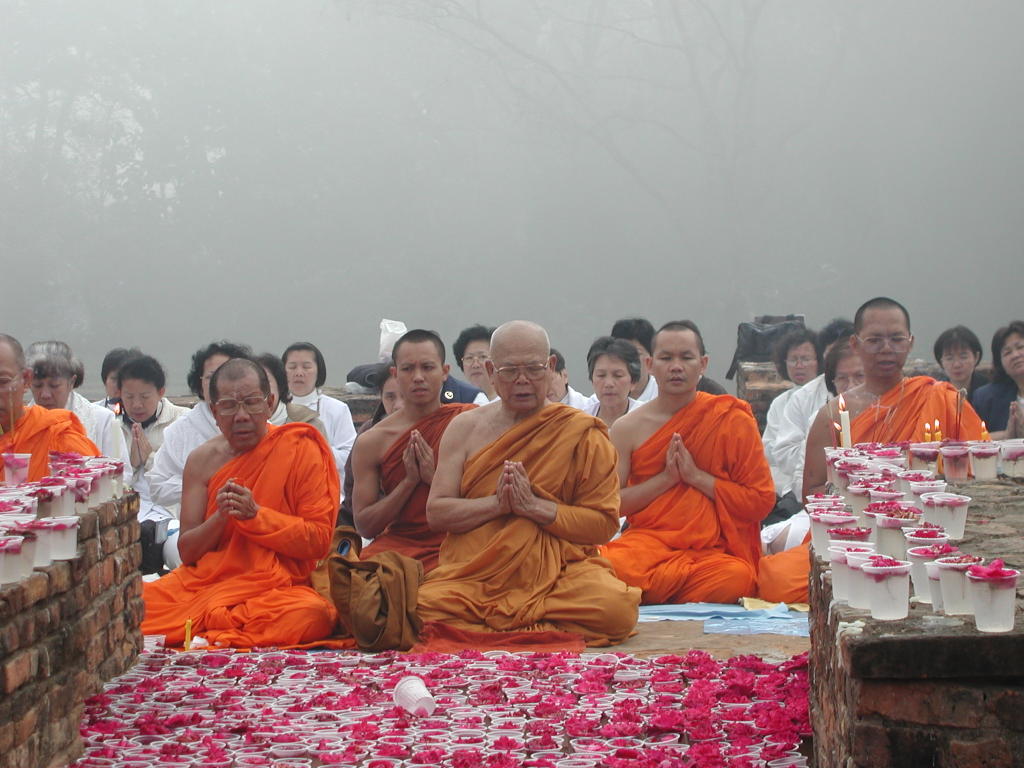
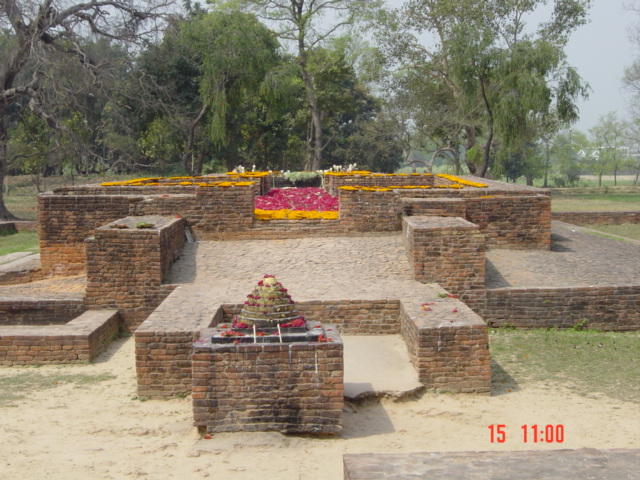
Handy monk is a Thai monk lives in WatThai,D.C. and have serving the Thai& American society in metropolitan area. He lives in the United States since 1992.

Monday, April 06, 2009

ชมวีดีโอท่องแดนพุทธภูมิอินเดีย-เนปาล

Thursday, October 06, 2005

รายการเดินทางไปนมัสการสังเวชนียสถานอินเดีย-เนปาล

รายการเดินทาง
นำนมัสการอัฐมหาสถาน(พุทธสถานสำคัญ ๘ แห่ง)
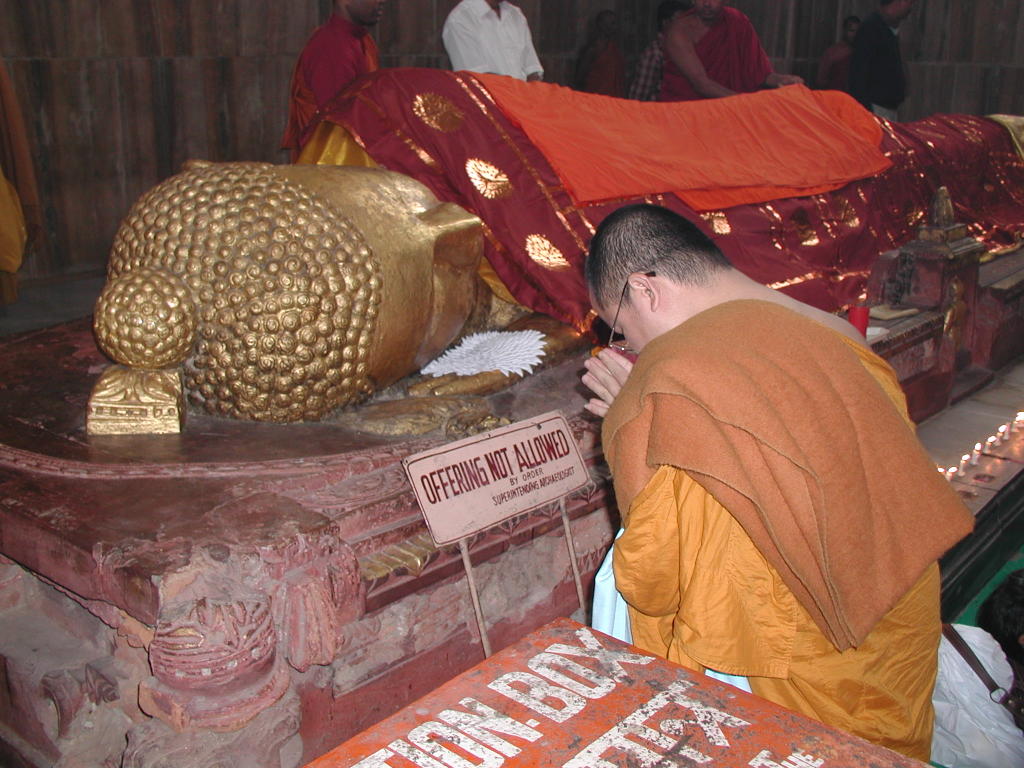
บำเพ็ญบุญบูชาคุณพระพุทธองค์
ณ ประเทศอินเดีย-เนปาล
ระหว่างวันที่ ๑๒-๒๒ มกราคม พ.ศ. ๒๕๔๙
*******

วันที่ ๑๒ มกราคม พ.ศ. ๒๕๔๙ (เดินทางจากกรุงเทพฯ สู่ดินแดนพุทธภูมิ)
เวลา ๑๑.๐๐ น. พร้อมกันที่สนามบินดอนเมืองอาคาร ๑ เคาน์เตอร์ที่ ๘ (Indian Airlines)
เวลา ๑๔.๐๐ น. ออกเดินทางจากท่าอากาศยานกรุงเทพฯโดยสายการบิน Indian Airlines
เวลา ๑๖.๐๐ น. (เวลาท้องถิ่น) ถึงสนามบินเมืองคยา (Gaya Airport)อินเดีย
เวลา ๑๗.๐๐ น. เข้าพักที่โรงแรม Royal Residency Hotel รับประทานอาหารเย็นแล้วไปกราบนมัสการองค์เจดีย์พุทธคยา สวดมนต์ไหว้พระ, เวียนเทียนรอบองค์พระเจดีย์ ชมบรรยากาศการสวดมนต์ของชาวพุทธนานาชาติในเวลากลางคืนตามอัธยาศัย
เวลา ๒๑.๓๐ น. กลับเข้าที่พัก

วันที่ ๑๓ มกราคม พ.ศ. ๒๕๔๙ (นมัสการองค์พระเจดีย์พุทธคยา-ชมวัดพุทธนานาชาติ)
เวลา ๐๖.๐๐ น. รับประทานอาหารเช้า แล้วออกเดินทางไปไหว้องค์พระเจดีย์ สถานที่ตรัสรู้และต้นพระศรีมหาโพธิ์ พระแท่นวัชรอาสน์ ที่ประทับนั่งตรัสรู้ในคืนวันเพ็ญเดือน ๖
นมัสการสัตตมหาสถาน คือ สถานที่เสวยวิมุตติสุข ๗ แห่ง ในบริเวณพระเจดีย์พุทธคยา นมัสการองค์หลวงพ่อพุทธเมตตาที่สวยงามด้วยพุทธลักษณะและศักดิ์สิทธิ์ที่สุดภายในองค์พระเจดีย์พุทธคยา เปิดโอกาสให้นั่งสมาธิ ฟังธรรมบรรยาย ถ่ายรูปเป็นที่ระลึก อย่างเต็มที่
เวลา ๑๑.๒๐ น.ฉันภัตตาหารเพลที่ภัตตาคารของโรงแรม พร้อมกับญาติโยมรับประทานด้วย
เวลา ๑๔.๐๐ น. ชมวัดนานาชาติ เช่น วัดทิเบต วัดญี่ปุ่น วัดภูฐาน วัดสิกขิม เป็นต้น ซึ่งอยู่รอบ ๆ พุทธคยา ชมแม่น้ำเนรัญชรา หมู่บ้านนางสุชาดา, ที่อธิษฐานลอยถาด, ที่รับหญ้าคาจากโสตถิยพราหมณ์ เป็นต้น
เวลา ๑๘.๐๐ น. ฉันน้ำปานะ และญาติโยมรับประทานอาหารเย็น ที่ภัตตาคารของโรงแรม
เวลา ๑๙.๐๐ น. ไปไหว้พระสวดมนต์เย็นที่เจดีย์พุทธคยา (ตามอัธยาศัย) เสร็จแล้วเข้าที่พัก

วันที่ ๑๔ มกราคม ๒๕๔๙ (พุทธคยา-พาราณสี)
เวลา ๐๖.๐๐ น. รับประทานอาหารเช้า
เวลา ๐๗.๐๐ น. ออกเดินทางจากเมืองพุทธคยา มุ่งหน้าสู่เมืองพาราณสี พักฉันเพลในระหว่างทาง ต้องใช้เวลาเดินทางประมาณ ๘-๙ ชั่วโมง
เวลา ๑๕.๐๐ น. ถึงเมืองสารนาถ เข้าชมพิพิธภัณฑ์สารนาถ ชมพระพุทธรูปที่มีพุทธลักษณะที่สวยงามที่สุดในโลก เสาหัวสิงห์พระเจ้าอโศก อายุ ๒,๓๐๐ กว่าปี และวัตถุโบราณที่ล้ำค่าหาดูได้ยาก และนำชมสถานที่สำคัญบริเวณเมืองสารนาถ เช่น เจาคัณทีสถูป สถานที่พระพุทธเจ้าพบกับปัญจวัคคีย์ทั้ง ๕ ชมวัดไทยสารนาถ กราบนมัสการพระพุทธรูปหินทรายที่งดงามที่สุด ทำบุญทอดผ้าป่าบำรุงวัดไทย ตามอัธยาศัย เป็นต้น
เวลา ๑๖.๐๐ น. เข้านมัสการธัมเมกสถูป สถานที่แสดงธรรมเทศนาครั้งแรก พร้อมกันไหว้พระทำวัตรเย็น และสวดบทพระธัมมจักกัปวัตตนสูตร, เวียนเทียนรอบองค์พระสถูปใหญ่, นมัสการมูลคันธกุฏีของพระพุทธเจ้า และเยี่ยมชมมูลคันธกุฎี(ใหม่)สมาคมมหาโพธิ์ของท่าน อนาคาริกธัมมปาละ ชมภาพจิตรกรรมฝาผนังที่งดงาม มีความละเอียดอ่อนทางด้านพุทธศิลป์
เวลา ๑๘.๐๐ น. เข้าที่พักที่โรงแรม Clark (หรือเทียบเท่า ๕ ดาว)

วันที่ ๑๕ มกราคม ๒๕๔๙ (ล่องแม่น้ำคงคาที่ศักดิ์สิทธิ์- ไปเมืองสาวัตถี)
เวลา ๐๔.๓๐ น. ออกจากที่พักไปยังแม่น้ำคงคาในเมืองพาราณสี นั่งเรือล่องแม่น้ำคงคาที่ศักดิ์สิทธิ์ของชาวฮินดู เป็นสถานที่อาบน้ำล้างบาป และมีท่าเผาศพซึ่งไฟไม่เคยดับจากเชิงตะกอนนานกว่า ๔,๐๐๐ ปี ชมเมืองพาราณสีที่เก่าแก่ไม่เคยร้าง
เวลา ๐๗.๐๐ น. รับประทานอาหารเช้าที่โรงแรม
เวลา ๐๙.๐๐ น. ออกเดินทางไปเมืองสาวัตถี
เวลา ๑๑.๐๐ น. ฉันภัตตาหารและญาติโยมรับประทานอาหารกลางวันแบบปิคนิค
เวลา ๑๖.๐๐ น. ชมสถานที่แสดงยมกปาฎิหาริย์ และไปชมซากบ้านของท่านอนาถบิณฑิกเศรษฐี มหาเศรษฐีผู้สร้างพระเชตวันมหาวิหารถวายพระพุทธองค์ จากนั้นชมซากบ้านเกิดของท่าน องคุลิมาล
เวลา ๑๘.๐๐ น. เข้าที่พัก ณ โรงแรม Nikko Lotus

วันที่ ๑๖ มกราคม ๒๕๔๙ (สาวัตถี )
เวลา ๐๗.๐๐ น. รับประทานอาหารเช้าที่โรงแรมที่พัก
เวลา ๐๘.๓๐ น. เข้าชมบริเวณวัดพระเชตวันมหาวิหาร และนมัสการพระคันธกุฎีของพระพุทธองค์, ทำวัตรสวดมนต์และสวดบทมงคลสูตร เพราะเป็นที่พระองค์แสดงครั้งแรก ,นมัสการกุฎิพระอรหันต์แปดทิศ, ชมหมู่กุฎิพระอรหันต์แปดสิบองค์ และอานันทโพธิ ต้นโพธิ์ที่เก่าแก่ในวัดพระเชตวันฯ
เวลา ๑๑.๐๐ น. พักฉันภัตตาหารเพลที่โรงแรม
เวลา ๑๓.๐๐ น. ชม แดนมหามงคล สาวัตถีเมืองแก้ว ของอุบาสิกาบงกช
เวลา ๑๙.๐๐ น. เข้าพัก ณ โรงแรม Nikko Lotus

วันที่ ๑๗ มกราคม ๒๕๔๙ (สาวัตถี-ลุมพินี)
เวลา ๐๖.๐๐ น. รับประทานอาหารเช้าที่โรงแรม
เวลา ๐๗.๐๐ น. ออกเดินทางจากเมืองสาวัตถี มุ่งหน้าสู่ประเทศเนปาล ผ่านด่านโสนารีรับประทานอาหารแบบปิกนิก ระหว่างทาง
เวลา ๑๕.๐๐ น. ถึงสวนลุมพินีวัน สถานที่ประสูติ เข้านมัสการมายาเทวีวิหาร เวียนเทียนรอบเสาอโศก นั่งสมาธิ แผ่เมตตา แวะเยี่ยมวัดไทยลุมพินี ทอดผ้าป่าบำรุงวัดตามอัธยาศัย
เวลา ๑๘.๐๐ น. เข้าพักโรงแรมนิวการ์เดน/ รับประทานอาหารเย็น/พักผ่อน

วันที่ ๑๘ มกราคม ๒๕๔๙ (ลุมพินี-กุสินารา)
เวลา ๐๖.๐๐ น. รับประทานอาหารเช้าที่โรงแรม
เวลา ๐๗.๐๐ น. กลับออกไปยังเมืองกุสินารา ผ่านด่านโสเนารีเข้าประเทศอินเดีย รับประทานอาหารกลางวันระหว่างทาง
เวลา ๑๕.๐๐ น. ถึงเมืองกุสินารา สถานที่ปรินิพพานของพระพุทธเจ้า เข้ากราบนมัสการพระพุทธปฏิมาปางปรินิพพานในวิหาร เวียนเทียนรอบองค์พระสถูปปรินิพพาน และสวดมนต์ทำวัตรเย็นร่วมกัน นั่งสมาธิ แผ่เมตตา จนได้เวลาอันสมควร/เข้ากราบนมัสการ และเวียนเทียนรอบพระสถูป มกุฎพันธนเจดีย์ สถานที่ถวายพระเพลิงพระบรมศพ
เวลา ๑๘.๐๐ น. เข้าพักที่โรงแรม Nikko Lotus /รับประทานอาหารเย็น/พักผ่อน

วันที่ ๑๙ มกราคม ๒๕๔๙ (กุสินารา-เวสาลี-ปัตนะ)
เวลา ๐๖.๐๐ น. รับประทานอาหารเช้าที่โรงแรม
เวลา ๐๗.๓๐ น. ออกเดินทางจากเมืองกุสินารา มุ่งหน้าสู่เมืองเวสาลี รับประทานอาหารกลางวันระหว่างทาง
เวลา ๑๕.๐๐ น. เข้านมัสการฐานพระสถูปที่เคยบรรจุพระบรมสารีริกธาตุสมัยกษัตริย์ลิจฉวีที่ได้ส่วนแบ่งจากเมืองกุสินารา พร้อมกันไหว้พระสวดมนต์ และสวดบทนมัสการพระสถูป, เวียนเทียนรอบฐานพระสถูป นั่งสมาธิ แผ่เมตตา-ชมสระอภิเษกที่ศักดิ์สิทธิ์ของเจ้าลิจฉวี ซึ่งยังมีน้ำใสเย็นเต็มเปี่ยมอยู่ตลอดเวลา
เวลา ๑๖.๐๐ น. เข้าชม “กูฎาคาร” ป่ามหาวัน สถานที่พระนางมหาปชาบดีพร้อมด้วยเจ้าหญิงศากิยะ ๕๐๐ องค์ ทูลขอบวชเป็นภิกษุณี ชมเสาสิลาจารึกของพระเจ้าอโศกที่หัวเสาเป็นสิงห์ยังสมบูรณ์แบบที่สุด นมัสการอานนทสถูป ซึ่งสร้างขึ้นเป็นอนุสรณ์แก่พระอานนท์
เวลา ๑๘.๐๐ น. เดินทางไปยังเมืองปาฏลีบุตร หรือเมืองปัตนะในปัจจุบัน ข้ามสะพานมหาตมะคานธีที่ยาวที่สุด
เวลา ๑๙.๓๐ น. เข้าพัก ที่โรงแรมChina Kayi ของเมืองปัตนะ /รับประทานอาหารเย็น

วันที่ ๒๐ มกราคม ๒๕๔๙ (ปัตนะ-นาลันทา-ราชคฤห์)
เวลา ๐๖.๐๐ น. รับประทานอาหารเช้าในโรงแรม
เวลา ๐๘.๐๐ น. เข้าชมอโศการาม ที่ทำสังคายนาครั้งที่ ๓ ของพระเจ้าอโศกมหาราช
เวลา ๐๙.๓๐ น. ออกเดินทางไปยังเมืองนาลันทา
เวลา ๑๑.๐๐ น. ฉันภัตตาหารเพลและญาติโยมรับประทานอาหารกลางวันระหว่างทาง
เวลา ๑๔.๐๐ น. ชมมหาวิทยาลัยนาลันทา (Nalanda University) ที่ใหญ่และเก่าแก่ที่สุดในประวัติศาสตร์พระพุทธศาสนา นมัสการพระสถูปที่นิพพานของพระสารีบุตร
เวลา ๑๖.๐๐ น. เข้าชมพระเวฬุวันมหาวิหาร วัดแห่งแรกในพระพุทธศาสนา ชมตโปธาร บ่อน้ำร้อนศักดิ์สิทธิ์ของชาวฮินดู ชมคลังสมบัติของพระเจ้าพิมพิสาร เป็นต้น
เวลา ๑๘.๐๐ น. เข้าสู่ที่พักที่โรงแรม Royal Residency Hotel รับประทานอาหารเย็น พักที่นี่ ๑ คืน

วันที่ ๒๑ มกราคม ๒๕๔๙ (ราชคฤห์-พุทธคยา)
เวลา ๐๖.๐๐ น. รับประทานอาหารเช้า
เวลา ๗๐.๐๐ น. ขึ้นภูเขาคิชกูฎ นมัสการพระคันธกุฏิของพระพุทธเจ้า, กุฏิพระอานนท์, ถ้ำสุกรขาตา ถ้ำพระสารีบุตร, ถ้ำพระมหาโมคคัลลานะ , ชมวัดชีวกัมพวัน, คุกที่คุมขังพระเจ้าพิมพิสาร
เวลา ๑๑.๐๐ น. ฉันภัตตาหารเพลที่โรงแรม Royal Residency Hotel, Rajgirh
เวลา ๑๓.๐๐ น. ถวายผ้าป่าทำบุญวัดไทยสิริราชคฤห์
เวลา ๑๕.๐๐ น. ออกเดินทางไปพุทธคยา และเข้าที่พัก ที่โรงแรม Royal Residency Hotel.
เวลา ๑๗.๐๐ น. เยี่ยมพระธรรมทูตวัดไทยพุทธคยา ทอดผ้าป่าบำรุงวัด
เวลา ๑๘.๐๐ น. กลับเข้าที่พัก รับประทานอาหารเย็ฯ
เวลา ๑๙.๐๐ น. ไปไหว้พระสวดมนต์ทำวัตรเย็น และนั่งสมาธิ แผ่เมตตาที่ต้นพระศรีมหาโพธิ์
เวลา ๒๑.๐๐ น. เข้าสู่ที่พักโรงแรม Royal Residency Hotel

วันที่ ๒๒ มกราคม ๒๕๔๙ พุทธคยา –กรุงเทพฯ
เวลา ๐๗.๐๐ น. รับประทานอาหารเช้า
เวลา ๐๘.๐๐ น. ออกเดินทางไปสนามบิน
เวลา ๐๙.๐๐ น. เช็คอินที่เคาน์เตอร์ Indian Airlines
เวลา ๑๑.๐๐ น. เครื่องบินออกเดินทางกลับสู่กรุงเทพฯ
เวลา ๑๔.๐๐ น. (ตามเวลาท้องถิ่น)เดินทางถึงท่าอากาศยานกรุงเทพ โดยสวัสดิภาพ

หมายเหตุ รายการเดินทางอาจจะมีการปรับเปลี่ยนได้ตามความสะดวก/ประหยัด และเหมาะสม
รายละเอียดค่าใช้จ่าย และการเตรียมตัวในการเดินทาง

๑. ค่าบริการ สำหรับฆราวาสท่านละ $ 1,250 (๔๙,๕๐๐ บาท) พระภิกษุท่านละ $ 1,100
(๔๕,๕๐๐ บาท) ซึ่งจะต้องใช้จ่ายดังรายการต่อไปนี้
ค่าใช้จ่ายนี้รวม; - ค่าตั๋วเครื่องบินชั้นทัศนาจรไป-กลับ กรุงเทพฯ-พุทธคยา - ค่าภาษีสนามบินทุกแห่งตลอดรายการ - ค่ารถโค้ชชั้นหนึ่งขนาด 35 ที่นั่ง(ปรับอากาศ)ตลอดการเดินทาง - ค่าที่พักตามที่ระบุไว้ในรายการ - ค่าอาหารทุกมื้อตามที่ระบุไว้ในรายการ, ค่าธรรมเนียมเข้าชมสถานที่ต่าง ๆ - ค่ามัคคุเทศก์ทั้งชาวไทยและชาวอินเดียพื้นเมืองอำนวยความสะดวกตลอดการเดินทาง, - ค่าขนกระเป๋าเดินทางและทิปต่างๆ
-กรุณานำกระเป๋าเดินทางใบใหญ่ไปไม่เกินท่านละ 20 กก.หากเกินกว่านั้นผู้เดินทางต้องจ่ายเพิ่มเองค่าใช้จ่ายนี้ไม่รวม; -ค่าธรรมเนียมหนังสือเดินทางและเอกสารต่างด้าว - ค่าใช้จ่ายส่วนตัวอื่นๆ เช่นค่าโทรศัพท์ โทรสาร ค่าซักรีด ค่าเครื่องดื่มและค่าใช้จ่ายนอกเหนือจากที่ระบุในรายการ ค่าภาษีมูลค่าเพิ่ม7%ภาษีการค้า3%(จากค่าบริการ)หมายเหตุ; * - ขอสงวนสิทธิ์ในความรับผิดชอบใดๆในส่วนของค่าใช้จ่ายที่อาจเพิ่มขึ้นในกรณีเกิดการล่าช้าหรือยกเลิกเที่ยวบินจากสายการบิน,อุบัติเหตุร้ายแรงตามธรรมชาติต่างๆ การนัดหยุดงานหรือปัญหาทางการเมืองที่เป็นเหตุสุดวิสัยอันทำให้เกิดการผิดพลาดจากรายการข้างต้น - กำหนดการเดินทางข้างต้นอาจมีการเปลี่ยนแปลงและ/หรือแก้ไขได้ตามความจำเป็นของ สถานการณ์ โดยจะถือเอาประโยชน์ของผู้เดินทางทุกท่านเป็นสำคัญ - คณะผู้จัดการเดินทางจะไม่รับผิดชอบใดๆทั้งสิ้น หากผู้ร่วมเดินทางไปกับคณะและนำสิ่งผิดกฎหมายหรือของต้องห้ามเดินทางไปกับคณะโดยเด็ดขาด๒. สัมภาระในการเดินทาง
กระเป๋าเดินทางนำไปได้ท่านละ ๑ ใบ น้ำหนักไม่เกิน ๒๐ ก.ก. และกระเป๋าถือสำหรับของใช้ส่วนตัว
๓. เงินตรา
เงินที่จะนำติดตัวไปต้องแลกเป็นเงินสกุลดอลล่าร์อเมริกัน เครื่องประดับ เช่นทองคำหนักไม่เกิน ๕ บาท (ไม่แนะนำให้แต่งตัวด้วยเครื่องประดับราคาแพง) ส่วนเงินบาทไทยจะนำติดตัวออกได้ไม่เกิน
๕๐,๐๐๐ บาท(ห้ามนำเงินรูปีเข้าไปเพราะผิดกฎหมาย)
๔. ยารักษาโรค และของใช้อื่น ๆ
สิ่งที่ควรนำติดตัวไปคือยารักษาโรคประจำตัว หรือ ยาแก้แพ้(เมารถ) ยาแก้ท้องเสีย เป็นต้น ร่มกันแดด ไฟฉายเล็ก ๆ เสื้อกันหนาว ผ้าพลาสติกรองนั่งสวดมนต์ ส่วนของใช้ที่เป็นโลหะมีคม เช่น ช้อน-ส้อม มีด หรือคัตเตอร์ อย่าใส่ไว้ในกระเป๋าถือติดตัวโดยเด็ดขาด ต้องใส่ไว้ในกระเป๋าใหญ่เท่านั้น กล้องถ่ายรูป หรือไฟฉายต้องนำเอาแบตเตอรี่ออกไว้ต่างหากขณะที่จะขึ้นเครื่องบิน เพราะไม่อนุญาตให้ถ่ายรูปในสนามบินอินเดีย
๕. ยืนยันการเดินทาง
ท่านที่ประสงค์จะร่วมเดินทางไปจาริกแสวงบุญนมัสการพุทธสถานในครั้งนี้ กรุณาติดต่อล่วงหน้าก่อนอย่างน้อย ๓ เดือน และจ่ายเงินก่อนล่วงหน้า ๖๐๐ เหรียญฯ พร้อมสำเนาหนังสือเดินทาง เพื่อจองตั๋วเครื่องบิน(ส่วนทำวีซ่าเข้าประเทศอินเดียให้ดำเนินการขอเองที่สถานทูตอินเดียในกรุงวอชิงตัน ดีซี.)
๖. ส่วนที่เหลือ ขอความกรุณาจ่ายส่วนที่เหลือประมาณสิ้นเดือนตุลาคมศกนี้
ค่าบริการนี้ไม่รวมค่าหนังสือเดินทาง ค่าวีซ่า ซึ่งท่านจะต้องไปทำหนังสือเดินทางด้วยตัวท่านเอง หนังสือเดินทางที่ยังใช้ได้ต้องมีอายุอยู่ไม่ต่ำกว่า ๖ เดือน ถ้าหมดอายุจะต้องต่ออายุหนังสือเดินทางก่อน
ถ้าท่านสงสัยประการใด โปรดติดต่อได้ที่
1. ดร.พระมหาถนัด อตฺถจารี ตำแหน่งพระธรรมทูตสายต่างประเทศ วัดไทยกรุงวอชิงตัน ดี.ซี. สถานที่ติดต่อ วัดไทยกรุงวอชิงตัน ดี.ซี. 13440 Layhill Road , Silver Spring , MD 20906
Tel.(301) 871-8660, 871-8661, fax. 301-871-5007 Mobile: 240-464-7091
E-mail: t_inthisan@hotmail.com, pemhandy@yahoo.com
2. พระมหาพัน สุภาจาโร วัดไทยพุทธคยา รัฐพิหาร อินเดีย โทร.07-053-3718(Thailand)
91-9431-042521(India) E-mail: p_bodhgaya@yahoo.co.in
ท่านที่สนใจจะร่วมเดินทางกรุณากรอกชื่อและที่อยู่ในแบบฟอร์ม ส่งไปที่
PhramahaThanat Inthisan Wat Thai Washington,D.C. 13440 Layhill Road, Silver Spring, MD 20906
Tel.(301) 871-8660, 871-8661, Fax.(301) 871-5007, E-mail: t_inthisan@hotmail.com , t_inthisan@rediffmail.com www.thanat.iirt.net, www.handytour.blogspot.com

ส่งด่วนภายในเดือนกันยายนนี้ และกรุณาวางมัดจำก่อน $ 600
สั่งจ่าย (Pay to) Thanat Inthisan ส่วนที่เหลือจ่ายภายในเดือนตุลาคม ๔๘ นี้


ขอเชิญร่วมเดินทางธรรมสัญจร สู่แดนพระพุทธองค์ ๑๒ วัน ๑๒ คืน
ระหว่างวันที่ ๑๔ – ๒๕ มกราคม พ.ศ. ๒๕๔๙ (Jan.14-25, 2006)
(รายละเอียดดูในรายการเดินทาง)
· อินเดีย แดนศิวิไลย์อันเร้าระทึกใจ นำท่านมนัสการพุทธสังเวชนียสถาน (อัฐมหาสถาน ๘ แห่ง) ในอินเดีย เนปาล
· การแสวงบุญสู่โลกแห่งความรุ่งเรืองอันสงบ สู่ดินแดนอันเป็นถิ่นกำเนิดแห่งพระพุทธศาสนา และตามรอยบาทแห่งองค์พระสัมมาสัมพุทธเจ้า
· เป็นการเดินทางสู่ความเรืองรองแห่งแสงพระธรรม และความรุ่งโรจน์ในอดีต
· ชมมหาราชวัง และความวิจิตรอันสุดลึกล้ำด้านศิลปะ
· สัมผัสวิถีชีวิต ของชาวอินเดีย ที่ยึดมั่นในหลักของศาสนาฮินดู และวัฒนธรรมที่เก่าแก่ที่สุดประเทศหนึ่งในโลก
ข้าพเจ้ามีความต้องการที่จะเดินทางร่วมไปกับคณะธรรมสัญจร สู่แดนพระพุทธองค์ และยินดีที่จะปฏิบัติตามรายการที่กำหนดไว้ทุกประการ

ชื่อ..............................................นามสกุล..............................................................
First Name……………………………………………………………..
Last Name……………………………………………………………..
Thai Passport No………………………………….U.S.Passport No…………………………...
Address…………………………………………………………………………
City……………………………………State………..Zip……………………..
Tel.(………)…………………………..(w.)………………………………(H.)
Fax.(……...)…………………………...E-mail:…………………………………

ท่านที่สนใจจะร่วมเดินทางกรุณากรอกชื่อและที่อยู่ในแบบฟอร์มนี้ ส่งไปที่
พระมหาถนัด อตฺถจารี วัดไทยกรุงวอชิงตัน ดี.ซี. 13440 Layhill Road, Silver Spring, MD 20906
Tel.(301) 871-8660, 871-8661, Fax.(301) 871-5007, E-mail: t_inthisan@hotmail.com, t_inthisan@rediffmail.com www.thanat.iirt.net, www.handytour.blogspot.com

ส่งด่วนภายในเดือนกันยายนนี้ และกรุณาวางมัดจำก่อน $ 600
สั่งจ่าย (Pay to) Thanat Inthisan ส่วนที่เหลือจ่ายภายในเดือนตุลาคม ๔๘ นี้

Tuesday, August 16, 2005

หนังสือทุกเล่มมีแจกที่วัดไทยฯดี.ซี.


ต้องการหนังสือเล่มนี้ติดต่อรับได้ที่วัดไทยฯดี.ซี.


Wednesday, August 03, 2005

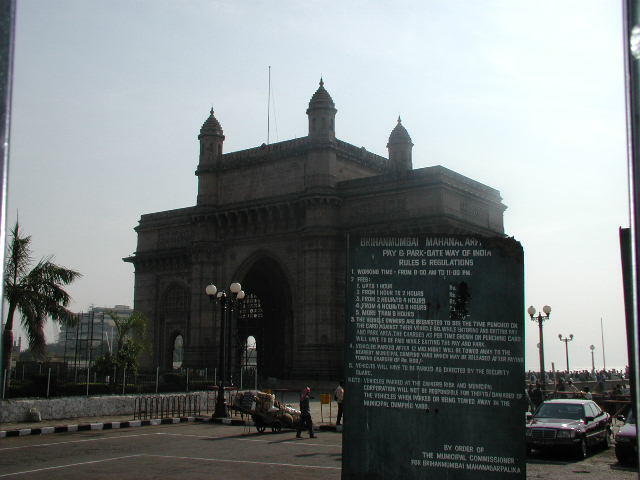
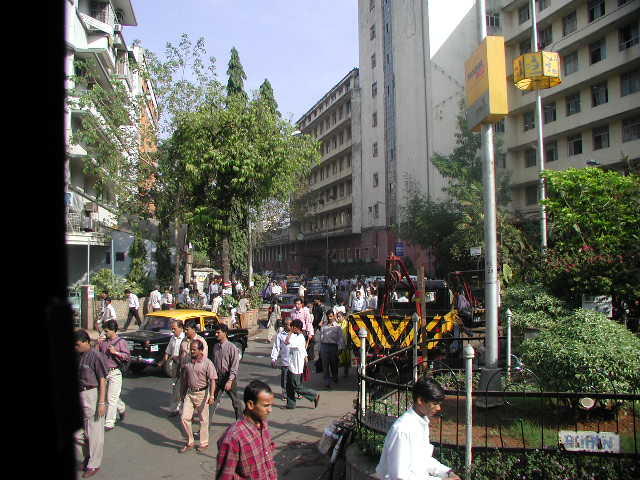
อำลาเมืองบอมเบย์ (Bombay)


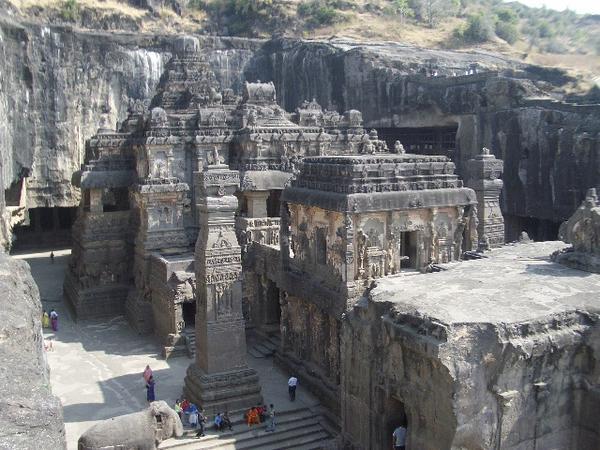
ถ้าเอลโลร่า (Ellora Caves)

The Ellora Temple Caves

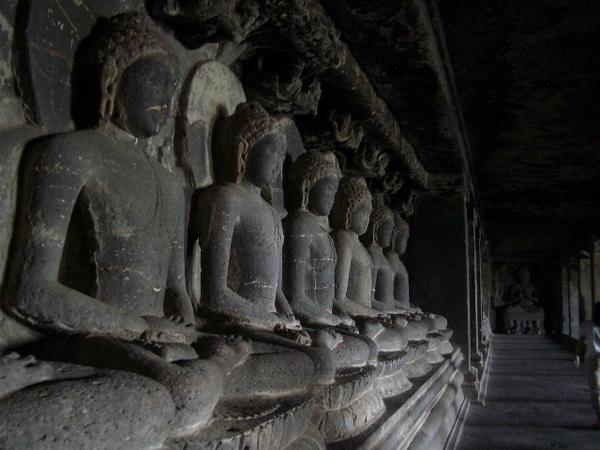
The Ellora temple caves are used for worship by different religions, namely Buddhism, Hinduism, and Jainism. These caves are a mile and a quarter long. They are located about eighteen and a half miles from the city of Aurangabad. There are twelve caves devoted to Buddhism, eighteen to Hinduism, and four to Jainism, thirty-four in all.

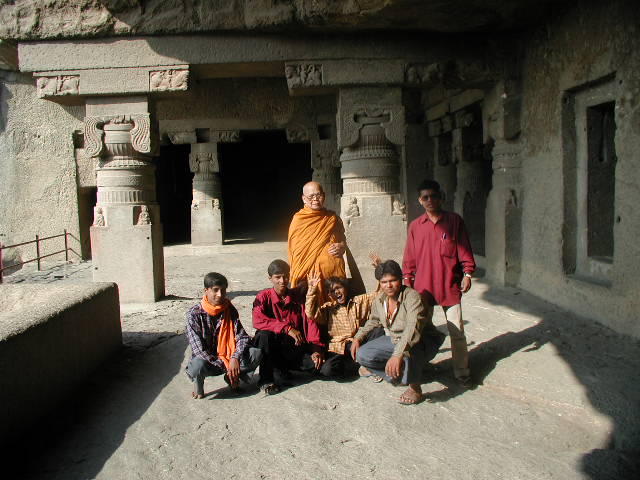
The Ellora caves, which date from the period 9 to 12 A.D., were constructed later than the Ajanta caves. Sometimes when people worshipped the Lord Buddha, they built caves to honor him. These caves also served as places for monks to perform Buddhist ceremonies and to study the Dhamma. Such was the case with the Ellora caves. Many carvings were produced in these caves. Because of changes in the religious leadership, there was a lack of support for the continued construction of some of the Ellora caves. Changes in leadership meant that some caves remained unfinished.

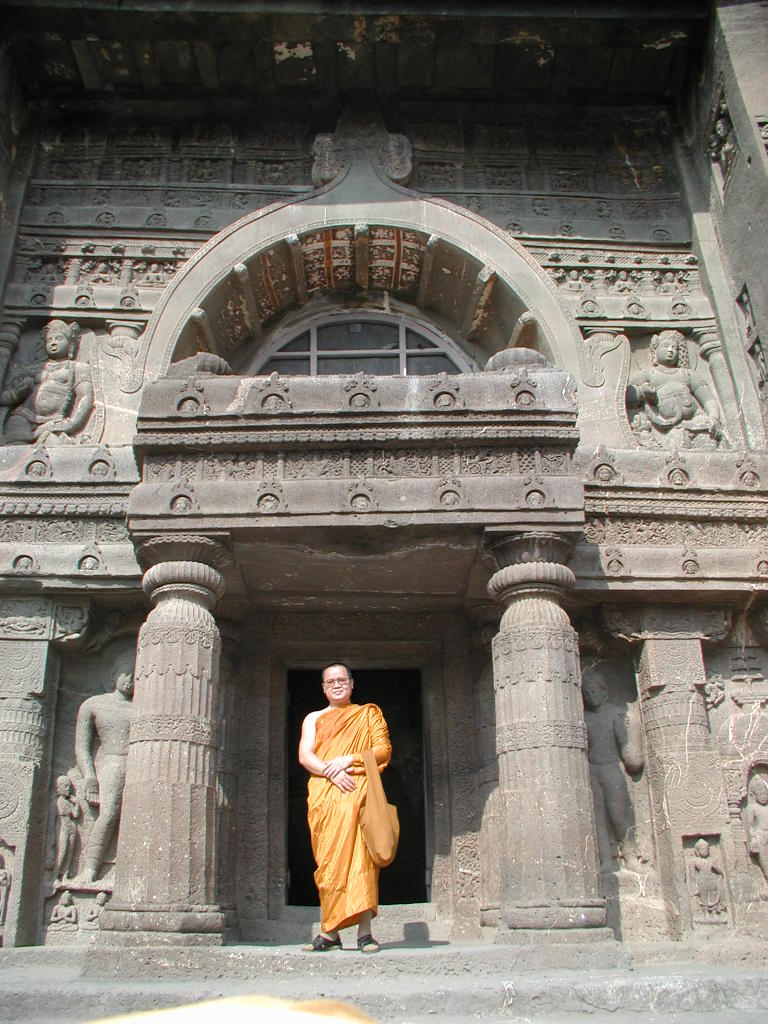
The most beautiful of the Ellora caves is the tenth. It is two stories high with a pagoda inside. The top floor has a large arched balcony extending outwards. There are stone carvings of hovering devas on the exterior face of the cave. The ceiling is a Sanchi-style dome. In the stupa there is a large Buddha image.

The eleventh and twelfth caves, which are considered to be more important than the other caves, are three stories high. Each story consists of a large residence hall (vihara) that the monks used. The monks’ cells extend off from the halls. The viharas are decorated with large columns and include balconies. Each top story, which contains many Buddha images lined up in a row, has a large Buddha sculpture. The fourth cave is currently used for Dhamma study, and the twelfth for merit ceremonies and as a monks’ quarters.

The seventeenth cave was the Hindu cave. The Hindu people wanted their caves to be a treasure of Hindu religion. They constructed caves thirteen through twenty-nine.

It was well known that the sixteenth cave, the Kailash cave, was the most beautiful of all the Ellora caves. This cave was carved from top to bottom out of a mountain. Altogether the stone that was removed weighed about 200,000 tons. The stone was carved into a very large and very beautiful Hindu-style temple. Around the temple walls and doors there are various forms of the Hindu god (tavathas) with his consort. Inside what was the monks’ residence is a large Shiva-lincum (phallus). On the ceiling of the temple is a carving of a lotus. Many Hindu people come here to worship. When they enter they feel that they are connected with their ancestors. Because the temple cave is so enormous, in every direction there are stone carvings of Hindu tavathas miles long.

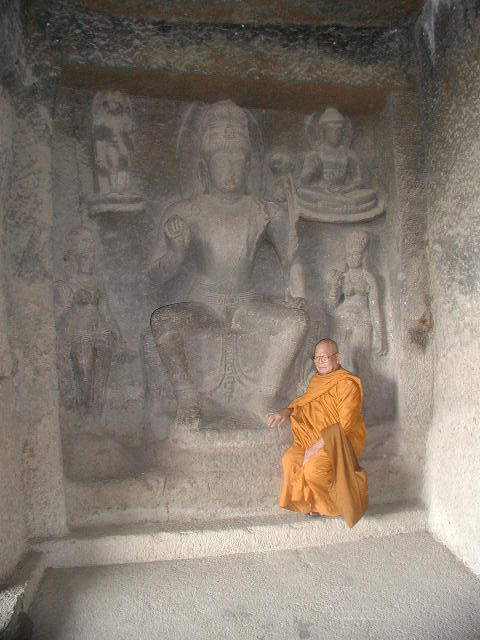
When the Jains were in power, they built caves that modeled the caves the Buddhists and Hindus had built. This is especially true of the thirty-second Jain cave. This temple cave contains a stone carving of Mahavira sitting in the meditation position under a banyan tree. Another carving depicts a naked male standing with a vine wrapped around his arms and legs. However, all thirty-four caves have carving of devas at the ceiling angles, as well as carvings covering the columns with large lotus petals at the capitals of the columns.

By PhramahaThanat Inthisan Ph.D.

Edited by Duwayne

August 26, 2005


ถ้ำอชันต้า (Ajanta Caves)


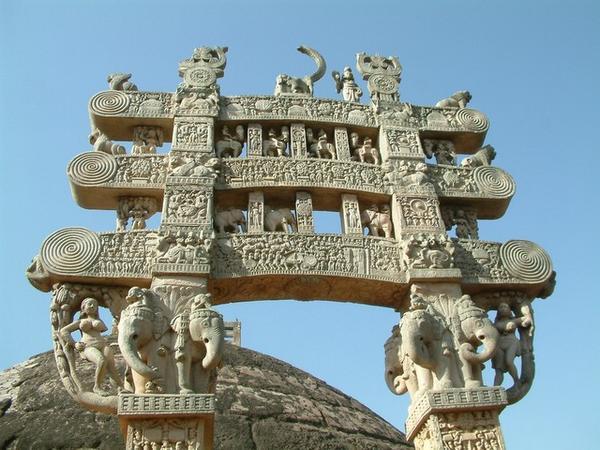
พระสถูปสาญจี เมืองโภปาล ประเทศอินเดีย


The Great Sanchi Stupa

The great Sanchi stupa looks like a huge bowl placed upside down. It has been well known since ancient times. Built between the years 200 B.C. to 200 A.D., it is the oldest stone structure from the era of Great King Asoka. The ancient hill of Sanchi was called Shikiri City of Jetiyakiri, jetiyakiri meaning the mountain with the pagoda on top. The Sanchi stupa is located in the Madhya Pradesh (state) in central India, about twenty-seven miles from the capital city of Bhopal. It is about 558 miles from New Delhi, about 124 miles from Bombay. It is situated atop a small mountain about 300 feet high. When viewed from a distance, it looks like a saddle on the back of a horse.

The ancient hill of Sanchi was in proximity to Ujayni, the capital city of Awanti. Awanti was the birthplace of Queen Devi, the first wife of Great King Asoka. When the king was traveling to Ujani to become a viceroy, he met the future queen on the way there at Vidisa and asked her to be his wife. The king was very fond of the hill near Vidisa and returned there to build a most beautiful stupa as an expression of gratitude to the Buddha. This Sanchi stupa was constructed to contain the Buddha’s relics.

The stupa is well preserved to this day. It is constructed of rectangular-shaped stones lined up in rows. It is about 120 feet in diameter and about 52.5 feet in height. The stupa is topped by a ceremonial umbrella (chatta). The area around the stupa is quite large and enclosed by stone balustrades. These balustrades are curved, designed to conform to the shape of the stupa. They are known as King Asoka Fence. All four entrances to the stupa have stone carvings of the Buddha depicting different periods of his life. There are carvings of the birth of the Buddha, Lumpini Grove where he was born, his reaching Enlightenment, his preaching the Dhamma, his leaving the palace to become a monk, and his passing into Nirvana. There are carvings of the Buddha converting the three ascetics. Another scene shows his relics being divided among the eight cities. There are even carvings which illustrate the lifestyles of the people of the time.

Two small stupas were subsequently constructed on either side of the larger one. The one on the right was built to enshrine the venerable Sariputta’s relics. The other small stupa on the left contains the venerable Maha Moggallana’s relics. The venerable Sariputta and the venerable Maha Moggallana were the Buddha’s chief disciples. There was also a sangkaram (temple, wat) at the rear. Another stupa at the temple holds the relics of Mokkalibutisa Thera, Great King Asoka’s teacher and the abbot of the temple, as well as the relics of arahants respected by the king.

Near the great stupa at the wat there was a Dhamma hall used for religious ceremonies. Only remnants of this building remain, including the bases of the stone columns. At the front of the great stupa there was a monolithic pillar, now broken. A long section of the pillar is now on the ground where the monks’ residence hall (vihara) used to be at the temple. The inscription on the piece of pillar states the following: “If anyone moves or destroys this stone pillar, that person will be punished.” The inscription warned that anyone tampering with the pillar was committing a sin.


By PhramahaThanat Inthisan Ph.D.

Edited by Duwayne

August 26, 2005


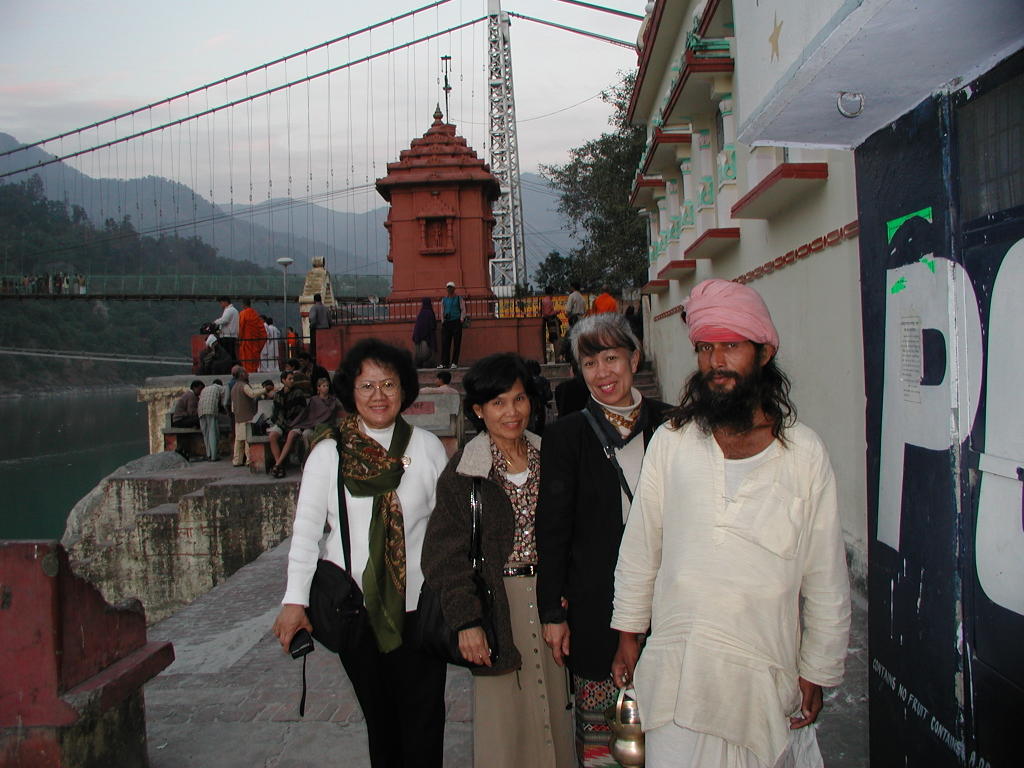
เมืองฤาษีเกษ และฮาริทวาร ต้นแม่น้ำคงคา


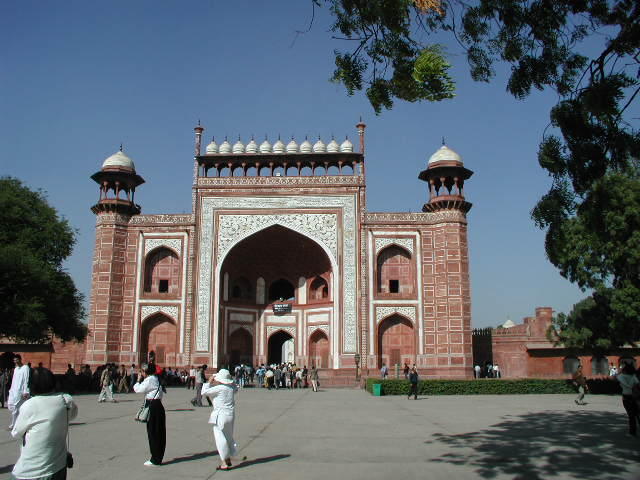
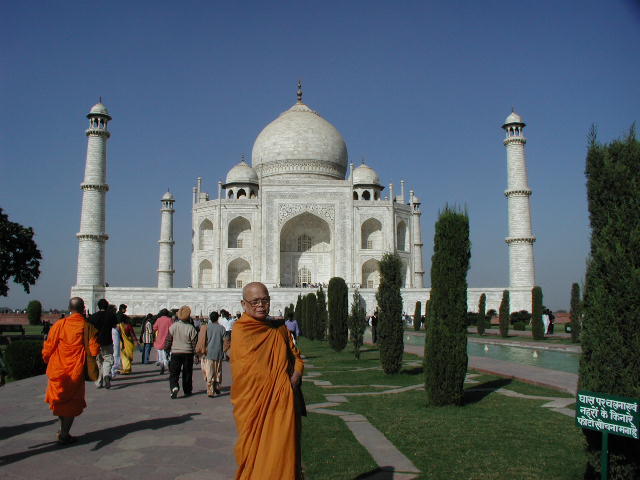
ทัชมาฮาล และอัคราฟอร์ด (


พระเชตวันมหาวิหาร เมืองสาวัตถี (Jetavana Sravasti)


กุสินารา สถานที่ปรินิพพาน (Kusinagar)


Kusinara, the Place of the Buddha’ Parinibbana


I. Location and Historical Significance

Kusinara (Kusinagar, Kushinagar) is the place where the Buddha passed away at the age of eighty (reached Mahaparinibbana, “the great fullness of Enlightenment”). It is about thirty-four miles east of Gorakhpur in the state of Uttar Pradesh in northern India. It is next to the town of Kasia (Kusia). Ancient Kasia, known as Kushavati, though not very large, was the center of the Malla tribe of eastern India. The Buddha himself provides some historical perspective on the old town. In the Mahaparinibbana Sutta, defending his choice of Kusinara as the place of his passing away in the face of Ananda’s opposition, the Buddha says that Kusinara, named Kusavati in previous times, was once a rich and populous capital that never slept, ruled by the righteous King Mahasudassana, who had conquered all the adjoining areas (cf. the “Mahaparinibbana Sutta: The Great Passing; The Buddha’s Last Days,” in The Long Discourses of the Buddha (Digha Nikaya), II:16.5.18).

Over the centuries following the Buddha’s death, Kusinara had an up-and-down history (cf. Middle Land, Middle Way; A Pilgrim’s Guide to the Buddha’s India, by Ven. S. Dhammika, p. 167, for what follows in the rest of this section). When Huien Tsiang came to Kusinara in the early part of the seventh century, the place was already in ruins. However, a few decades later when I Tsing came, there were more than one hundred monks there, with five hundred there during the pilgrimage season. When the Korean Hye Ch’o traveled there about 725 A.D., the place was once again in decline. The site was more or less abandoned. After 725 A.D., even before the Muslim invasions, historical records are silent about Kusinara.

After hundreds of years of neglect following the Muslim invasions, Kusinara was rediscovered in the middle of the nineteenth century. At the suggestion of H. H. Wilson in 1854 that the town of Kasia might be Kusinara, Alexander Cunningham visited the area in 1861-62 and agreed with Wilson’s assessment. In 1876 Cunningham’s assistant, A. C. L. Carlleyle, excavated the area around Kasia. He found the large reclining Buddha statue currently exhibited in the Nirvana Temple at Kusinara. However, only after further excavations between 1904 and 1912 which produced seals and an inscription was there conclusive proof that Kasia was ancient Kusinara. Just as the Burmese played a key role in the preservation of the shrine of Bodh Gaya through their missions to repair the premises, so, too, did they play a role in the rejuvenation of Kusinara. For in the 1900s Venerable U. Chandramani, a monk from Burma, made a pilgrimage to Kusinara, built a temple there, and in the following years took care of the visitors who began coming. In 1956 the Government of India built the presently existing Nirvana Temple at Kusnara in conjunction with the Buddha Jayanti Celebrations, the 2500th anniversary of the Buddha’s death, when Buddha Jayanti Park was built in Delhi.


II. The Story of the Buddha’s Passing Away:
a Synopsis of the Text

The Mahaparinibbana Sutta in the Digha Nikaya is the story of the Buddha’s passing away. The first two-thirds of the sutta (II:16.1.1-4.43) deal with a variety of topics leading up to the final journey to Kusinara: the discussions on morality, the Noble Truths, and the Mirror of Dhamma; the trip to the grove of Ambapali, the courtesan, and the meal with her; the Buddha’s sickness at Beluva during the rainy season; the discussion of the Dhamma as an island and of the four roads to power; the evil Mara’s visit with the Buddha at Capala Shrine three months before the Parinibbana; the discussion of the eight stages of mastery and eight stages of liberation; the discourse to the assembly of the monks in the Great Forest; the Buddha’s final trip to Vesali for alms; the discourse to the monks at Bhandagama and several other locations; the meal prepared by Cunda, the smith, at Pava and the Buddha’s ensuing sickness; and the visit of Pukkusa, a student of Alara Kalama, with the Buddha on his final journey from Pava to Kusinara.

Of the events leading up to the trip to Kusinara, the incident involving Cunda is important and instructive (cf. 4.13-20, 4.42). The Buddha, Ananda, and a large group of monks traveled to Pava to the mango grove of Cunda, the smith. The Buddha instructed him on the Dhamma. Cunda, in turn, offered to prepare a meal of “pig’s delight.” After the Buddha had eaten the meal, he became so sick it was as if he were going to die. However, he endured his sickness with mindfulness and did not complain. He then suggested to Ananda that they journey to Kusinara. While resting on the road, the Buddha exhibited his special powers by making the dirty water of a stream clean so that Ananda could bring him it to him to drink. Later the Buddha instructed Ananda on what to say to Cunda so that the latter would not feel remorse about the sickness he had caused.

The last third of the Mahaparinibbana Sutta (II:16.5.1-6.28) covers the passing away of the Buddha and the events immediately prior to this. The Buddha, Ananda, and a large group of monks crossed the Hirannavati River to the sala grove near Kusinara in preparation for the Parinibbana. At the Buddha’s behest, Ananda prepared a bed between two sala trees with the head to the north. The Buddha was tired and wanted to lie down. The Buddha told Upavana, standing in front fanning him, to move to the side so the devas from ten world-spheres could see him. They knew he would take leave of the earth in the last watch of the night, and they wanted to see him while they had the chance. Ananda asked the Buddha what was to be done with his remains. The Buddha said his remains were to be treated like the remains of a “wheel-turning monarch” (5.11): they were to be wrapped 500 times in cotton and a new cloth, placed in an iron oil-vat, and cremated on a perfumed funeral pyre; then a stupa was to be built at the crossroads. Ananda wept at the thought of the Buddha’s passing away, but he reminded his disciple that everything pleasant and delightful is changeable, i.e., that everything that is born decays. Ananda expressed the wish that the Buddha not die in the miserable little town of Kusinara, but the latter recounted the glorious history of ancient Kusavati and its ruler, King Mahasudassana. The Buddha sent Ananda to Kusinara to tell the Mallas there of his imminent passing away. The Mallas came to the sala grove with great weeping and, family-by-family, paid homage to him.

It happened at that time that a wanderer by the name of Subhadda was in Kusinara. Hearing that the Buddha was about to pass away, he went to the sala grove to gain Enlightenment. Though Ananda insisted several times that Subhadda not disturb the Buddha, the Buddha urged his disciple to let the wanderer see him. Subhadda asked the Buddha if the famous ascetics and Brahmins had realized the truth, or not. The Buddha, typically, refused to be drawn into a debate about other doctrines. His tact was to shift the focus to the efficaciousness, therefore validity, of his own teaching: only the Dhamma with the Noble Eightfold Path had produced Stream-Winners, Once-Returners, Non-Returners, and Arahants (cf. 5.27). (This little passage is quite significant for providing some insight into the way in which the Buddha “defends” his teaching in the face of contending doctrines without engaging in debate. It can be studied in the context of two other masterful pieces: the “Dighanakha Sutta; To Dighanakha,” in The Middle Length Discourses of the Buddha (Majjhima Nikaya), Number 74 (“debate” by accepting a view at face value and showing it is untenable (Dighanakha’s “Nothing is acceptable to me”) (74.6-8); and the ensuing brief analysis of material form, and of kinds of feelings, here representative of all mental factors—an analysis which leads to liberation (9-13)); and the “Satipatthana Sutta; The Foundations of Mindfulness,” in The Middle Length Discourses, No. 10 (a full-blown analysis of material forms, mental factors, etc.: mindfulness/insight meditation leading to liberation).) Subhadda subsequently saw the truth of the Dhamma and was ordained—the Buddha’s last personal disciple.

The Buddha spoke further, first to Ananda, then to the assembly of the monks. He told Ananda he would have no successor: the only teacher after his death would be the Dhamma itself. To the assembly of the monks he spoke his last words: “all conditioned things are of a nature to decay—strive on untiringly” (6.7).

Having gone through the various jhanas and Spheres, the Buddha passed away (cf. 6.8-6.9: the four jhanas and the various Spheres, e.g., the Sphere of Neither-Perception-Nor-Non-Perception, the Sphere of No-Thingness, etc.; cf., also, 3.33: the eight liberations). A terrible earthquake occurred, together with thunder. Some of the monks wept passionately; others bore their loss mindfully. The next morning the monk Anuruddha sent Ananda to Kusinara to tell the Mallas about the death of the Buddha. The Mallas, anguished and sorrowful, came to pay homage, paying respect with song and dance for six days. On the seventh day they carried the body through the city to the shrine of Makuta-Bandhana and wrapped the body in linen and cotton wool. The Venerable Kassapa the Great, who had been traveling from Pava to Kusinara with an entourage of monks, went to the Mallas’ shrine to pay homage. Once he had done so, the funeral pyre ignited by itself, and the Buddha’s body was burned so that only the bones remained. The leaders of eight cities—Magadha, Vesali, Kapilavatthu, Allakappa, Ramagama, Vethadipa, Pava, and Kusinara—laid claim to the relics of the Buddha. The Brahmin Dona divided the relics among the eight cities. The leaders of the eight cities built stupas for the relics, Dona build a stupa for the urn, and the Moriyas of Pipphalavana built a stupa for the embers in their city.

III. What to See at Kusinara Today

Why go to Kusinara? It is one of the four sites the Buddha himself recommended the faithful visit: the place of his birth, Lumbini Park; the place of his Enlightenment, Bodh Gaya; the place of his first discourse, Sarnath—and the place of his passing away, Kusinara (cf. 5.8 of the Mahaparinibbana Sutta).

Kusinara today is noteworthy both for the ancient monuments to be found there as well as for the temples that have recently been built (for the following, cf. D. C. Ahir, Buddhism in Modern India, pp. 46-48; cf., also, Dhammika, Middle Land, Middle Way, pp. 168-169). The temple by which Kusinara is recognized today is the Nirvana Temple with its barrel-vaulted roof and its large round glass windows. It is at the site of the ancient temple, which also had a barrel-vaulted roof. The Nirvana Temple is noteworthy for the large reclining Buddha statue that it contains. This statue, twenty feet long and dating from the 400s A.D., was carved from one piece of red sandstone. Carlleyle found it in 1876 when he excavated at the site of the original temple. Behind the Nirvana Temple is the main stupa, seventy-five feet high, which was restored by Venerable U. Chandramani, the Burmese monk, in 1927. There is some difference of opinion about whether the Buddha passed away at the spot where the temple exists or where the stupa exists. (According to Ahir, p. 47, the reclining statue in the temple is thought to be the place where the Buddha died. According to Dhammika, p. 168, however, the stupa marks the spot. Dhammika argues that the present stupa consists of stupas within stupas, in the first of which were found charcoal and black earth, presumably from a funeral pyre. It is not clear why material from the site of the creation stupa were be present in the main stupa.) Down the road and south of the Nirvana temple and the main stupa lies the Matha-Kuar temple. It should be noted that this is the temple that was built in 1927 by the Burmese to hold a large Buddha statue. This statue, ten feet high and about 1000 years old, represents the Buddha in the earth-touching position under the bodhi tree at the time of his Enlightenment. About one mile east of the Matha-Kuar temple is the remains of the cremation stupa, the Makutabandhana Chaitya (the site of the Mallas shrine) or Ramabhar stupa (from the name of the nearby pond), where the Buddha’s body was burned. The cremation stupa was a drum-shaped structure. It was large: it was 112 feet in diameter, its base 155 feet in diameter. Modern temples, lastly, have also been constructed at Kusinara by the people of China, Sri Lanka, Thailand, and Japan.


วัดเวฬุวันมหาวิหาร เมืองราชคฤห์ (Veluwanamahavihar)


มหาวิทยาลัยนาลันทา (Nalanda University)


เจดีย์รอบ ๆ เจดีย์พุทธคยา


พุทธคยา สถานที่ตรัสรู้ ตั้งอยู่ทางฝั่งตะวันตกของ แม่น้ำเนรัญชรา ณ ตำบลโพธิคยา หรือ พุทธคยา มีอาณาเขต ติดต่อกับตำบลตารดิตถ์ จังหวัดคยา รัฐพิหาร ซึ่งมีเมือง ปัตนะเป็นเมืองหลวง ก่อนจะเดินทางถึงบริเวณสถานที่ตรัสรู้ คือ ต้นพระศรีมหาโพธิ เราจะมองเห็นพระวิหารโพธิ (พระเจดีย์ ๔ เหลี่ยม) ตั้งตระหง่านสูงประมาณ ๑๗๐ ฟิตจากพื้นดิน เมื่อเดินเข้าใกล้เราจะมองเห็นว่าสถานที่รอบ ๆ ที่ตรัสรู้นี้ ตั้งอยู่ในที่ต่ำลึกจากระดับพื้นดินบริเวณรอบ ๆ ที่ถูกสร้างเป็น กำแพงในปัจจุบันประมาณ ๕ เมตร ที่เป็นเช่นนี้ เพราะบริเวณ พระศรีมหาโพธิ์ในอดีต มีวิหารใหญ่ ๓ หลัง เฉพาะทางประตู ด้านทิศเหนือของต้นพระศรีมหาโพธิ์ มีวิหารชื่อมหาโพธิสังฆาราม ซึ่งกษัตริย์ชาวศรีลังกาได้มาสร้างไว้ มี ๖ ห้อง ๔ ยอด มีพระสงฆ์อยู่อาศัยถึง ๑,๐๐๐ รูป แต่ใน พ.ศ. ๑๗๔๗ วิหารทั้ง ๓ หลัง รวมทั้งกำแพงได้ถูก ทำลายลงโดยกษัตริย์มุสลิม ดังนั้น บรรดาซากถาวรวัตถุที่ปรักหักพังได้ตกสลายไป ทำให้เกิดการทับถมกันของแผ่นดิน บริเวณนี้จึงอยู่ต่ำจากระดับกำแพงและบริเวณ รอบซึ่งเป็นซากวัดในอดีตประมาณ ๕ เมตร
เมื่อวันที่ ๒๗ มิถุนายน พ.ศ. ๒๕๔๕ องค์การสหประชาชาติได้ประกาศยกย่อง ให้พุทธคยาเป็นมรดกโลก
สถานที่ตรัสรู้
เจ้าชายสิทธัตถะ หรือดาบสสิทธัตถะในขณะนั้น หลังจากที่ทรงใช้ความวิริยะ อุตสาหะเพื่อแสวงหาโมกขธรรมอยู่เป็นเวลา ๖ ปี ได้ทรงตรัสรู้อนุตตรสัมมาสัมโพธิญาณ เป็นพระพุทธเจ้า ณ ภายใต้ต้นพระศรีมหาโพธิ์ เมื่อวันพุธ ขึ้น ๑๕ ค่ำ เดือน ๖ ปีระกา (วันวิสาขบูชา) ก่อนพุทธศักราช ๔๕ ปี พุทธคยาจึงจัดเป็นสถานที่สำคัญของพุทธศาสนิกชนตั้งแต่นั้นเป็นต้น มา บริเวณสถานที่ตรัสรู้นี้ ในครั้งพุทธกาลเรียกว่าตำบลอุรุเวลาเสนานิคม

พระแท่นวัชรอาสน์(Vajarasana)


Bodhi Tree, ตันพระศรีมหาโพธิ์ ที่พุทธคยา


ต้นพระศรีมหาโพธิ
ต้นพระศรีมหาโพธิ์ เป็นสถานที่ ที่สมเด็จพระสัมมาสัมพุทธเจ้าตรัสรู้ประทับ นั่งตรัสรู้ในคืนวันเพ็ญวิสาขปุรณมี ก่อน พุทธศักราช ๔๕ ปี ณ สถานที่นี้ได้เคยมีพระ พุทธเจ้าองค์อื่น ๆ ในอดีตกาลถึง ๓ พระองค์ ที่ได้ทรงตรัสรู้แล้ว คือ พระสัมมาสัมพุทธเจ้า กกุสันโท โกนาคมนะ กัสสปะ และพระพุทธเจ้า องค์ปัจจุบัน และในอนาคตกาล จะเป็นที่ตรัสรู้ ของพระศรีอริยเมตไตรยต้นที่ปรากฏอยู่ใน ปัจจุบัน เป็นต้นที่ ๔ มีประวัติโดยสังเขปดังนี้
ต้นพระศรีมหาโพธิ์ต้นที่ ๑
ต้นพระศรีมหาโพธิ์ที่พระพุทธองค์ได้ประทับนั่ง เพื่อตรัสรู้พระอนุตตรสัมโพธิญาณ เป็นสหชาติกับพระพุทธเจ้า อายุประมาณ ๓๕๒ ปี พระศรีมหาโพธิ์ต้นนี้ ถูกพระนางมหีสุนทรี มเหสีองค์ที่ ๔ ของพระเจ้าอโศกมหาราช ราดยาพิษและน้ำร้อนจนตาย พระเจ้าอโศกทรงเสีย พระทัยมาก ทรงอธิษฐานและสั่งให้เอาน้ำนมวัวถึง ๑๐๐ ตัวมารดหน่อของพระศรีมหาโพธิ์ จึงงอกขึ้นมาใหม่
ต้นพระศรีมหาโพธิ์ต้นที่ ๒
พระเจ้าอโศกทรงปลูกเมื่อ พ.ศ. ๒๗๒ ในช่วงปี พ.ศ. ๑๑๔๓ - ๑๑๖๓ กษัตริย์ชาว ฮินดูแห่งแคว้นเบงกอล ชื่อ ศาศางกา ได้ทำลายเสีย ต่อมากษัตริย์แคว้นมคธชื่อ พระเจ้าปุรณวรมา ทรงทราบข่าว จึงเสด็จมาที่พุทธคยา ได้ทรงเห็นต้นพระศรีมหาโพธิ์ถูกทำลาย จึงทรงให้เอา น้ำนมวัว ๑,๐๐๐ ตัว มารดจนหน่อของพระศรีมหาโพธิ์เกิดใหม่อีก
ต้นพระศรีมหาโพธิ์ต้นที่ ๓
พระเจ้าปุรณวรมา ได้ทรงปลูกหน่อต้นพระศรีมหาโพธิ์ต้นที่ ๓ นี้ไว้ ณ ตำแหน่ง เดิม จนต้นเจริญงอกงามดี ต้นที่ ๓ นี้ มีอายุประมาณ ๑,๒๕๖ – ๑,๒๗๖ ปี ก็ตายลงด้วยถูก พายุพัดโค่น เพราะอายุแก่มากแล้ว ต่อมา เซอร์คันนิ่งแฮม ได้เห็นหน่อของต้นพระศรีมหาโพธิ์ งอกขึ้นมา ๒ หน่อ จึงเอาหน่อที่สูงประมาณ ๖ นิ้ว ปลูกไว้ที่เดิม หน่อที่สูงประมาณ ๔ นิ้ว ปลูกไว้ทางทิศเหนือขององค์พระเจดีย์
ต้นพระศรีมหาโพธิ์ต้นที่ ๔
ท่านเซอร์คันนิ่งแฮมได้นำมาปลูกไว้ เมื่อ พ.ศ. ๒๔๒๓ ณ ตำแหน่งเดิมของต้น พระศรีมหาโพธิ์ต้นแรก พระศรีมหาโพธิ์ต้นนี้มีอายุประมาณ ๑๒๔ ปี ( พ.ศ.๒๕๔๗ ) นับแต่ปลูกมา ปัจจุบันต้นพระศรีมหาโพธิ์ ก็ยังแข็งแรงและสมบูรณ์ดี มีการกั้นรั้วทองเหลืองไว้โดยรอบ มีประตูเหล็กดัดสูง ๒ เมตร สร้างถวายโดยชาวพุทธศรีลังกา
๒. พระแท่นวัชรอาสน์
พระแท่นวัชรอาสน์ คือ ที่ประทับนั่ง ตรัสรู้ของสมเด็จพระสัมมาสัมพุทธเจ้า ที่ใต้ต้นพระศรีมหาโพธิ์ ในครั้งนั้น พระ พุทธองค์ทรงใช้หญ้ากุสะ ๘ กำมือ ที่ โสตถิยะพราหมณ์ถวายให้มาปูลาดนั่ง และเมื่อพระองค์ได้ตรัสรู้เป็นพระสัมมา-สัมพุทธเจ้าแล้ว บัลลังก์ที่ประทับนั่งนั้น จึงถูกเรียกว่า อปราชิตบัลลังก์ หรือ รัตนบัลลังก์
ต่อมา พระเจ้าอโศกมหาราชทรงสร้างเป็นแทนหินสลัก ประดิษฐานไว้ระหว่างต้น พระศรีมหาโพธิ์กับองค์พระเจดีย์ เพื่อให้เป็นอนุสรณ์สถานที่ถาวรยาวนาน พระแท่นนี้สร้างขึ้น โดยใช้แผ่นหินทราย เป็นรูปสี่เหลี่ยมผืนผ้า ยาวประมาณ ๗ ฟุต ๑๐ นิ้วครึ่ง กว้าง ๔ ฟุต ๗ นิ้วครึ่ง ความหนา ๖ นิ้วครึ่ง แกะสลักเป็นรูปแหวนเพชร นอกจากนั้น ยังมีรูปดอกบัว รูปพญาหงษ์ และดอกมณฑารพด้วย

Friday, July 29, 2005

พระแท่นวัชรอาสน์(Vajarasana) และรัตนจงกรมเจดีย์


พระมหาเจดีย์พุทธคยา หรือพระวิหารมหาโพธิ์
พระมหาเจดีย์พุทธคยานี้ ก่อสร้างด้วยหิน ทรายสีน้ำตาลนวล มีลักษณะเป็นทรง สี่เหลี่ยมจัตุรัส ยอดแหลมคล้ายยอดพระเจดีย์ทั่วไป มีความสูงประมาณ ๑๗๐ ฟุต ฐานวัดโดย รอบได้ ๘๖ เมตร พระเจ้าหุวิชกะ ทรงสร้างต่อมาจากสมัยพระเจ้าอโศกมหาราช และมีการ ซ่อมแซมบูรณะเรื่อยมา โดยท่านผู้เลื่อมใสในพระ พุทธศาสนา ดังนั้น องค์พระเจดีย์จึงมีทรงเป็นเหลี่ยม ที่มียอดแหลม นอกจากนี้ยังมีองค์เจดีย์เล็กๆ ลดหลั่น กันไปอยู่โดยรอบพระเจดีย์องค์ใหญ่ จึงทำให้พระเจดีย์ มีความงามยิ่งขึ้น มีห้องสำหรับปฏิบัติธรรมอยู่ชั้นบน ส่วนชั้นล่างนั้น ประดิษฐานพระประธานขนาดใหญ่ สูงประมาณ ๑.๖๖ เมตร หน้าตักกว้าง ๑.๔๗ เมตร แกะสลักด้วยหินตามแบบศิลปะสมัยปาละ มีอายุประมาณ ๑,๔๐๐ ปี องค์พระพุทธรูป ทาสีทองสวยงามมาก คนไทยนิยมเรียกว่า พระพุทธเมตตา
๔. อนิมิสเจดีย์
หลังจากตรัสรู้แล้ว พระองค์ประทับนั่ง เสวยวิมุติสุข ณ บัลลังก์ที่ประทับนั่งตรัสรู้ ตลอด ๗ วัน เทวดาบางพวกเกิดความปริวิตกว่า แม้วันนี้ พระสิทธัตถะ ยังมีกิจที่จะต้องทำอยู่เป็นแน่ เพราะยังไม่ละความอาลัย ในบัลลังก์ ด้วยพระองค์ทรงตั้งสัตยาธิษฐานไว้ก่อน ประทับนั่งว่า ถ้าไม่ได้ตรัสรู้อนุตตรสัมมาสัมโพธิญาณ จะไม่เสด็จลุกขึ้นจากบัลลังก์นี้ ในวันที่ ๘ ทรงออก จากสมาบัติ ทรงทราบความปริวิตกของเทวดาเหล่านั้น แล้วเหาะขึ้นไปในอากาศ เพื่อกำจัดความสงสัยของ เทวดาเหล่านั้น ทรงแสดงยมกปาฏิหาริย์ ครั้นแสดงยมกปาฏิหาริย์กำจัดความสงสัย ของเทวดาเหล่านั้นแล้ว จึงประทับยืนทางด้านทิศตะวันออกเฉียงเหนือเยื้องจากบัลลังก์ไป เล็กน้อย ทรงจ้องดูบัลลังก์และต้นโพธิ์ สถานที่บรรลุผลแห่งพระบารมีทั้งหลาย ที่ทรงบำเพ็ญ มาถึงสี่อสงไขยแสนกัปป์ ด้วยดวงพระเนตรที่ไม่กระพริบว่า เราบรรลุสัพพัญญุตญาณเหนือ บัลลังก์นี้ ทรงยับยั้งอยู่ ๗ วัน สถานที่นั้นจึงชื่อว่า อนิมิสเจดีย์
ปัจจุบันได้สร้างเป็นเจดีย์องค์ใหญ่มีสีขาว อยู่ทางด้านขวามือของบันไดที่จะลง สู่มหาโพธิสถาน หรือทางทิศตะวันออกเฉียงเหนือของพระเจดีย์มหาโพธิ์ ดูผิวเผินมีรูปทรง คล้ายกับเจดีย์องค์ใหญ่ แต่ลวดลายหยาบกว่า

๕. รัตนจงกรมเจดีย์
ในสัปดาห์ที่สาม พระองค์ทรง เนรมิตที่จงกรมระหว่างบัลลังก์ที่ประทับนั่งตรัสรู้ กับอนิมิสเจดีย์ ทรงจงกรมบนรัตนจงกรม จากทิศ ตะวันออกจรดทิศตะวันตกอยู่ตลอดสัปดาห์ สถานที่นั้นจึงชื่อว่า รัตนจงกรมเจดีย์ ปัจจุบัน มีหินแกะสลักทำเป็นดอกบัว ศิลปะภารหุต ประมาณ ๑๒ ศอก วางเรียงกันเป็นแนวยาวตลอด อยู่ทางด้านซ้ายมือข้างองค์พระมหาเจดีย์ พุทธคยา หรืออยู่ทางทิศเหนือ สร้างเป็นแท่นหินสูง ๑ เมตร มี ๑๙ ดอก
๖. รัตนฆรเจดีย์
ในสัปดาห์ที่ ๔ เทวดาทั้งหลายเนรมิตเรือนแก้วด้านทิศตะวันตกเฉียงเหนือของ ต้นโพธิ์ พระผู้มีพระภาคเจ้าทรงนั่งขัดสมาธิในเรือนแก้วนั้น ทรงพิจารณาอภิธรรมปิฏก และพระสมันตปัฏฐาน อนันตนัยในพระอภิธรรมปิฏกโดยพิเศษ ทรงยับยั้งอยู่ตลอดสัปดาห์ ส่วนนักอภิธรรมกล่าวว่า ที่ชื่อว่า เรือนแก้ว ไม่ใช่เรือนที่ทำด้วยแก้ว ๗ ประการ แต่สถานที่ที่ ทรงพิจารณาปกรณ์ทั้ง ๗ เรียกว่า เรือนแก้ว ท่านประยุกต์เรื่องทั้งสองเข้าไว้ในที่นี้โดยปริยาย จึงควรถือเอาทั้งสองนัย สถานที่นั้นจึงชื่อว่า รัตนฆรเจดีย์
ลักษณะที่ปรากฏในปัจจุบัน เจดีย์นี้สร้างเป็นทรงสี่เหลี่ยมผืนผ้า หลังคาตัดตรง ทาสีเหลือง ด้านหน้ามีประตูทางเข้า หันหน้าไปทางกำแพงด้านทิศเหนือ ภายในมีพระพุทธรูป ทองเหลืองขนาดใหญ่องค์หนึ่ง ประดับอย่างสวยงามประดิษฐานอยู่
๗. อชปาลนิโครธ
พระพุทธเจ้าประทับอยู่ใกล้ๆ ต้นโพธิ์ ๔ สัปดาห์แล้ว ในสัปดาห์ที่ ๕ เสด็จออก จากบริเวณควงไม้โพธิ์เสด็จข้ามแม่น้ำเนรัญชราไปทางทิศตะวันออก ประทับนั่งพิจารณาพระธรรม และเสวยวิมุตติสุขที่ต้นอชปาลนิโครธนั้น ณ ที่ตรงนี้ พราหมณ์ผู้ทิฏฐมังคลิกะ เที่ยวตวาดว่า หึ หึ ด้วยอำนาจความถือตัว ได้ทูลถามพระผู้พระภาคเจ้าว่า บุคคลชื่อว่าเป็นพราหมณ์ด้วยเหตุเพียง เท่าไร ธรรมเหล่าไหนทำให้บุคคลเป็นพราหมณ์ พระผู้มีพระภาคเจ้าทรงเปล่งอุทานแสดง เหตุและธรรมที่ทำให้บุคคลเป็นพราหมณ์
๘. สระมุจลินท์
ครั้นประทับนั่ง ณ อชปาลนิโครธตลอด ๗ วัน ในสัปดาห์ที่ ๕ แล้ว จึงเสด็จไป ประทับ ณ โคนต้นมุจลินท์ (ต้นจิกนา) อีกสัปดาห์หนึ่ง พอประทับนั่งในที่นั้นเท่านั้น มหาเมฆซึ่งมิใช่ฤดูกาลก็เกิดขึ้นเต็มทั่วห้องจักรวาล เมื่อมหาเมฆเกิดขึ้นแล้ว พญานาคชื่อมุจลินท์ คิดว่า เมื่อพระพุทธเจ้ามาสู่สถานที่ของเรา มหาเมฆก็เกิดขึ้น พระองค์ควรได้อาคารที่ ประทับ พญานาคแม้จะสามารถเนรมิตวิมานทิพย์ เหมือนกับเทพวิมาน แต่คิดว่า เมื่อเราสร้างวิมาน อย่างนี้ จักไม่มีผลมากแก่เรา เราจะขวนขวาย ด้วยกายตนเองเพื่อพระทศพล จึงทำอัตตภาพ ให้ใหญ่ยิ่งล้อมพระพุทธเจ้าไว้ด้วยขนด ๗ ชั้น แผ่พังพานไว้ข้างบน พระผู้มีพระภาคประทับอยู่ ณ บัลลังก์มีค่ายิ่งที่สำเร็จด้วยรัตนะ ๗ ประการ เพดานมีพวงดอกไม้หอมหลายชนิดห้อยอยู่ เบื้องบน อบอวลด้วยกลิ่นหอมนานาชนิด ในโอกาสใหญ่ภายในขนดล้อม เหมือนประทับอยู่ในพระคันธกุฏี ตลอด ๗ วัน ณ ที่ตรงนี้ พระพุทธองค์ได้ทรงเปล่งอุทานปรารภความสุข ๔ ประการ เมื่อฝนหยุดแล้ว พญานาคราชจึง คลายขนดจำแลงเป็นมาณพยืนประคองอัญชลีถวายบังคมพระผู้มีพระภาคเจ้าทางเบื้อง พระพักตร์
สระมุจลินท์ อยู่ห่างจากเจดีย์พุทธคยาไปทางทิศตะวันออกเฉียงใต้ประมาณ ๒ กิโลเมตร ห่างจากแม่น้ำเนรัญชราประมาณครึ่งกิโลเมตร มีสระน้ำอยู่ใกล้หมู่บ้านชื่อมุจลินท์ ในปัจจุบัน ทางการได้จำลองสระมุจลินท์ไว้ที่บริเวณเจดีย์พุทธคยา มีพระพุทธรูปปางนาคปรก อยู่กลางสระ ติดกับกำแพงด้านวัดป่าพุทธคยา
๙. ราชายตนะ
ในสัปดาห์สุดท้ายแห่งการเสวยวิมุติสุข พระพุทธองค์เสด็จเข้าไปประทับนั่ง ณ ราชายตนะ (ต้นเกด) ทรงยับยั้งอยู่ด้วยสุขในฌานและสุขในผล
สถานที่นี้ อยู่ทางทิศใต้ของต้นพระศรีมหาโพธิห่างจากแม่น้ำเนรัญชราไปทาง ทิศตะวันตกประมาณ ๑ กิโลเมตร อยู่ห่างจากสระมุจลินท์ไปประมาณ ๕๐๐ เมตร มีต้นโพธิ์ขึ้น แทนต้นเกด ชาวฮินดูได้สร้างเทวสถานไว้ใกล้ ๆ มีทางเข้าต่อจากถนนเรียบแม่น้ำเนรัญชรา ฝั่งตะวันตกไปทางทิศใต้

Vesali มหานครแห่งเจ้าลิจฉลี และพระเจดีย์สันติภาพ


เวสาลี


ที่ตั้ง
เมืองเวสาลี ตั้งอยู่ทางฝั่งทิศเหนือของแม่น้ำคงคา ในเมืองมูซัฟฟาปูร์ห่างจาก เมืองปัตนะเมืองหลวงของรัฐพิหาร ประมาณ ๔๔ กิโลเมตร มีแม่น้ำคงคากั้นกลางเป็นพรม แดนธรรมชาติระหว่างแคว้นมคธกับแคว้นวัชชีในอดีต ทิศเหนือจรดภูเขาหิมาลัย ทิศใต้จดแม่น้ำ คงคา ซึ่งกันระหว่างวัชชีกับมคธ ทิศตะวันออกจดแม่น้ำโกสี, เกาสิกี ทิศตะวันตกจดแม่น้ำคันฑัก
ประวัติเมืองเวสาลี
เป็นเมืองหลวงของแคว้นวัชชี เป็นเมืองใหญ่หนึ่งในเจ็ดของอินเดียโบราณ ที่ได้ ชื่อว่าเวสาลี เพราะเป็นเมืองของพระเจ้าววิสาละ ในชาดกกล่าวว่า เมืงอเวสาลีล้อมรอบด้วย กำแพง ๓ ชั้น แต่ละชั้นห่างกัน ๑ คาวุต ที่กำแพงมีประตูหอคอยและคฤหาสน์ ใกล้เมือง เวสาลีม่ป่ามหาวัน ในป่านั้นมีวัดอยู่วัดหนึ่งชื่อกูฏาคารศาลา ในมหากาพย์รามายณ์ กล่าวว่า โอรสของอิกสวากุเทพบุตร และอลัมพุษเทพธิดา เป็นผู้สร้างเมืองนี้
ความเกี่ยวข้องกับพุทธประวัติ
กำเนิดปริตร สมัยหนึ่งเมืองเวสาลีเกิดอหิวาตกโรคขึ้น เจ้าลิจฉวีนามว่า มหาลิ ได้ไปทูลนิมนต์ให้พระพุทธเจ้าเสด็จไปยังเมืองเวสาลี พระพุทธเจ้าได้เสด็จไปยังเมืองเวสาลี พร้อมด้วยภิกษุ ๕๐๐ รูป แล้วให้พระอานนท์เรียนรัตนสูตร ทำปริตรในระหว่างกำแพงสามชั้น ในเมืองเวสาลี เมืองโรคระงับแล้ว พระพุทธองค์ได้ตรัสรัตนสูตรโปรดเวไนยสัตว์อยู่เจ็ดวัน มีผู้บรรลุธรรมเป็นจำนวนมาก
ในพรรษาที่ ๕ พระพุทธองค์ได้เสด็จจำพรรษาในกรุงเวสาลี ณ กูฏาคาร ศาลา ป่ามหาวัน มีพระสูตรหลายสูตรและหลายชาดกที่พระพุทธเจ้าทรงแสดง ที่เมืองเวสาลี เช่น มหาลิสูตร ขาลิยสูตร มหาสีหนาทสูตร จูฬสัจจกสูตร มหาสัจจกสูตร เตวิชสูตร สุนักขัตตสูตร รัตนสูตร เตโลรทชาดก สิคารชาดก
พระนางมหาปชาบดีโคตมี มีพระทัยน้อมไปในบรรพชา จึงได้เสด็จเข้าไปเฝ้า พระพุทธเจ้าพร้อมด้วยนางสากิยานี ๕๐๐ คน ซึ่งขณะนั้น พระพุทธองค์ประทับอยู่ที่กูฏาคาร ศาลาป่ามหาวัน พระพุทธองค์ทรงอนุญาต โดยให้ประพฤติครุธรรมแปดประการ
พรรษาสุดท้าย พระพุทธเจ้าทรงเสด็จจำพรรษาสุดท้ายที่เมืองนี้ ในหมู่บ้าน เวฬุคาม เมื่อออกพรรษาแล้ว ทรงดำเนินเรื่อยไปโดยพระบาทผ่านหมู่บ้านน้อยใหญ่ในเมืองนี้ เมื่อเสด็จถึงทิวาวิหารที่ปาวาลเจดีย์ทรงหยุดพัก ณ ที่ตรงนี้ ได้ตัดสินพระทัยที่จะปลงอายุสังขาร ว่าต่อไปนี้อีก ๓ เดือน พระองค์จะเสด็จปรินิพพาน แล้วเสด็จผ่านหมู่บ้านต่าง ๆ ในเมือง เวสาลีจนกระทั่งเสด็จเข้าสู่เมืองกุสินารา
ทำสังคายนา เมืองเวสาลี เป็นสถานที่ทำสังคายนาครั้งที่สองเพื่อชำระพระธรรม วินัยระงับ ข้อปฏิบัติที่ผิดพระธรรมวินัยของภิกษุพวกวัชชีบุตรหลังพุทธปรินิพพาน ๑๐๐ ปี พระ อรหันต์ร่วมในพิธี ๕๐๐ รูป ใช้เวลาทำสังคายนา ๕ เดือน
สมณะเฮี่ยนจัง กล่าวไว้ในจดหมายเหตุว่า อาณาจักรเวสาลีมีเนื้อที่ ๕,๐๐๐ ลี้ เป็นถิ่นอุดมสมบูรณ์ ประชาชนมีความซื่อสัตย์ มีรายได้ดี รักการศึกษา ได้พบสิ่งก่อสร้าง ทางพระพุทธศาสนาเป็นจำนวนร้อน ส่วนใหญ่ปรักหักพังรกร้างใก้เมืองยังมีวัดอยู่แห่งหนึ่ง มีพระไม่กี่รูป อยู่ในนิกายสัมมิติยะ เถรวาท ท่านได้ไปเยี่ยมวัดเสวตปุระมีนักบวชฝ่ายมหายาน อาศัยอยู่ ได้พบที่บรรจุพระธาตุพระอานนท์ด้วย หลังจากที่หลวงจีนเฮี่ยนจังได้ไปมาแล้ว สถานการณ์พระพุทธศาสนาในเมืองเวสาลี เป็นที่ทราบได้น้อยมาก
สถานที่สำคัญ
หลักศิลาที่ค้อธนา มีเสาหินตั้งเด่นเป็นสง่า ซึ่งได้จัดทำขึ้นโดยพระเจ้าอโศกมหาราช ซึ่งอยู่ห่างจากหมู่บ้านมาสาธออกไปทางตะวันออกเฉียงเหนือประมาณ ๓ กิโลเมตร เป็นเสา หินทรายขัดมัน มีเจดีย์ตั้งอยู่เรียงรายรอบเสาหินของพระเจ้าอโศก บนเสาหินมีรูปสิงโตตัวเดียว ซึ่งถือว่ายังสมบูรณ์ที่สุดในภูมิภาคนี้ที่ไม่ถูกทำลาย
พระสถูปองค์ที่หนึ่ง พระถังซังจั๋งได้บันทึกไว้ว่า อยู่ทางทิศตะวันออกเฉียงเหนือ ของเสาหินพระเจ้าอโศก เป็นกองเนินดินอิฐ เป็นที่รู้กันว่าเป็นสถูปที่ ๑ มีความสูงประมาณ ๑๕ ฟิต ในที่ไม่ห่างออกไปนัก ได้มีการค้นพบผอบบรรจุพระอังคารของพระพุทธองค์ แต่ในคัมภีร์ กล่าวว่า กษัตริย์ชาววัชชีได้รับพระบรมสารีริกธาตุของพระพุทธองค์ส่วนหนึ่งจากแปดส่วน ที่เมืองกุสินารา
พระสถูปองค์ที่สองในปีพ.ศ. ๒๕๐ กรมศิลปากรของประเทศอินเดีย ได้ทำการ ขุดค้น และพบผอบบรรจุพระอังคารของพระพุทธเจ้าเหมือนกัน ชาวญี่ปุ่นได้สร้างหลังคาครอง องค์สถูป เพราะเหลืออยู่แต่ส่วนฐานอยู่ระดับเดียวกับพื้นดิน
สระน้ำราชาภิเษกของกษัตริย์ลิจฉวี เป็นสระน้ำศักดิ์สิทธิ์ ซึ่งเป็นสระต้องห้าม ประจำเมืองเวสาลี สำหรับราชตระกูลกษัตริย์ผู้ปกครองเมืองเวสาลีเท่านั้นที่จะใช้สรงสนาน และน้ำที่นำมาใช้สำหรับกษัตริย์ที่จะขึ้นครองราชย์ จะต้องนำน้ำจากสระนี้มาประกอบ พิธีมุรธาภิเษกเป็นกษัตริย์
วาลุการาม เป็นวัดในเมืองเวสาลี แคว้นวัชชี เป็นที่ประชุมทำสังคายนาครั้งที่ ๒ ปัจจุบันมีเฉพาะส่วนที่เหลือจากการทำลายพอเป็นหลักฐานคือ ตรงส่วนเป็นรูปบาตรคว่ำของ เจดีย์ไม่มีปลาย เนื่องจากชาวฮินดูตั้งไว้บูชา เพราะไม่มียอดจึงดูเหมือนศิวลึงค์ แต่มีพระพุทธรูป ปรากฏอยู่รอบ ๆ เป็นหลักฐานว่านี้คือ วัดของพุทธ
โกลเหา เป็นหมู่บ้านเล็กๆ อยู่ทางทิศตะวันตกเฉียงเหนือของเมืองบาร์ชาร์ ๒ ไมล์ เดิมเป็นชานเมืองของเวสาลีได้พบเสาศิลาของพระเจ้าอโศกมหาราชที่หมู่บ้านนี้ ทางทิศ ใต้ของเสาศิลานั้นไปประมาณ ๕๐ ฟุต มีบ่อน้ำบ่อหนึ่ง เรียกกันว่า รามกุนท นักโบราณคดี เชอร์ คันนิ่งแฮม มีมติว่า เขาขุดบ่อน้ำนี้ถวายพระพุทธเจ้า ไปทางทิศตะวันตกของเสา ศิลาประมาณ ๑๕ ฟุต ฐานกว้างประมาณ ๖๕ ฟุต เชื่อกันว่า พระเจ้าอโศกโปรดให้สร้างไว้ พระสถูปใช้อิฐก่อเป็นห้องแบบใหม่ มีบันไดหลายชั้นเลียบผนังขึ้นไป ประดิษฐพระพุทธรูป ปางสะดุ้งมารเป็นศิลปสมัยปาละ
มัญฌิ เป็นหมู่บ้านอยู่ทางทิศตะวันตกเฉียงเหนือของฉัประ ประมาณ ๑๒ ไมล์ ทางทิศตะวันตกเฉียงใต้ของมัญฌิ มีรากฐานป้อมโบราณ ที่อนุสาวรีย์เล็กในป้อมมีพระพุทธ รูปองค์หนึ่งสูง ๑๓ นิ้ว อนุสาวรีย์นั้นเรียกว่า มาเธศวร
เกสรียา เป็นเมืองที่ค้นพบใหม่ ห่างจากปัตนะประมาณ ๑๒๐ กม. มีพระสถูปสูง ประมาณ ๑๔๕ เมตร สูงกว่าพุทธคยาและมีพระพุทธรูปประทับนั่งปางสะดุ้งมารเป็นประธาน ในวิหาร แต่เสียดายเศียรพระพุทธรูปถูกทุบทำลายที่ค้นพบใหม่ในเร็วนี้ สันนิษฐานว่า น่าจะ เป็นหมู่บ้านของชาวเกสบุตรนิคม ที่เรียกเพี้ยนมากจาก เกสปุตตนิคม มาเป็น เกสริยา น่าจะเป็นพุทธสถานที่สำคัญแห่งใดแห่งหนึ่งแน่นอน
กำแพงและตัวเมืองเวสาลี ตั้งอยู่ใกล้แม่น้ำคัณฑกะ ต่อมาแม่น้ำเปลี่ยนทิศทางเดิน แม่น้ำเก่ากลายเป็นทะเลสาบ กำแพงของเมืองเป็นเนินดินสูงใหญ่และยาว ทางการไม่ได้ขุด แต่งอะไรมากนัก มีเสาหินใหญ่เสาหนึ่งตั้งอยู่หน้ากำแพงเมืองเวสาลี สูงประมาณ ๒๐ ฟุต เป็นเสาหินสร้างใหม่ มีภาษาฮินดีจารึกไว้บนเสาว่า “รัฐบาลพิหาร” เป็นผู้สร้างนำมาประดิษฐ์ ณ ที่ตั้งเมืองเวสาลีโบราณ เมื่อวันที่ ๑๐ เมษายน พ.ศ. ๒๔๘๙ บนยอดเสาทำเป็นฉัตร ๓ ชั้น คูเมืองหน้ากำแพง ก็ปรากฏอยู่เป็นคูตื้นเขินตามกาลเวลา มีกำแพงสูงจากพื้นดินข้างละประมาณ ๘ เมตรมีความแข็งแรงมาก วัดโดยรอบเกือบ ๑ ไมล์

ลุมพินีวัน สถานที่ประสูติ (Lumbini or Rummindei,Nepal)

Lumbini Park, the Birthplace of the Buddha


I. Geography

The Buddha was born in the ancient village of Lumbini (Sanskrit for the lovely, named after Lumbini, married to Suprabuddha, the ancient king of Devadaha; also spelled as Rummindei, the queen of King Anjana of Devadaha). Lumbini lay in the district of Rupandehi near the ancient town of Kapilavastu (Bhairahawa, Piprahwa, Siddhartha Nagar) in the southwestern part of the Terai region of Nepal at the foothills of the Churia (Chure) mountain range (also Siwalik mountain range). The Himalayas, including Mount Everest, lie further to the northeast. Bhairahawa, about two and a half miles from Sunauli at the Indian border, is one hundred eighty-six miles west-southwest of the capital of Nepal, Kathmandu, and about sixty-eight miles north of the Indian city of Gorakhpur in Uttar Pradesh. The Terai region of Nepal is a narrow strip of fertile land about sixteen to twenty miles wide running across the southern part of the country from the far west to the far east. The ancient village of Lumbini no longer exists. At the time of the Buddha’s birth, there was a grove of sala trees there. The site of the birthplace remained unknown until 1886, when a German archeologist, Alois Fuhrer, discovered the Asoka pillar located there.

II. The Story of the Buddha’s Birth

In Buddhist tradition the Buddha was born at Lumbini in 563 B.C. The ruler of the kingdom at that time was King Suddhodana of the Shakya dynasty of the Kshatriya, warrior, caste. The capital city of his kingdom was Kapilavastu. His queen was Maya Devi.

According to the Buddhist text, one night at the palace during the Midsummer Festival, the queen had a dream that four Brahmins came to her bedside. They carried her to a place under a sala tree in the Himmapan forest. There were devas and other spiritual beings waiting there to attend to her. Then they took her to Anodard pond to be purified of her sins. Suddenly a white elephant (the future Buddha) brought her a white lotus flower in his trunk and made a triple circumambulation around the queen. Striking her on her right side, he seemed to enter her womb. (Cf. the Introduction (Nidana Katha) to the Jataka Commentary (i.4721), paragraphs 27-28).

The next morning the queen told the king her dream. The king called sixty-four Brahmins together to interpret the dream. They told the king that the queen had become pregnant and would have a son. If his son continued to live in the household, he would become a great monarch. On the other hand, if he left the household and abandoned the world, he would become a Buddha. When the time of birth came near, the queen asked the king for permission to return to her hometown of Devadaha to give birth to their child. According to the custom of the time, a woman ready to give birth had to go to her parents’ house to have her child. King Suddhodana consented and ordered a large number of royal attendants to accompany the queen on the trip. (Some sources indicate the queen traveled to Lumbini specifically to worship the sacred tree there.) The entourage traveled about twelve and a half miles, arriving at Lumbini garden on the fifteenth day of the sixth lunar month. The beautiful garden and the peaceful neighboring areas belonged to both the Shakyas and the Koliyas clans. The day was a Friday, the day of a full moon. (This date is currently celebrated every year on the day of the full moon in May.) Since it was almost noon, the weather was getting hot. So the queen ordered the attendants to stop so she could rest for a while. However, it was not long before she felt labor pains. She reached up and supported herself by holding the branch of a sala tree. Thereafter the queen, standing under the sala tree, gave birth to her son as the birds were singing. (Cf. the Introduction to the Jataka (i.4721), paragraphs 29-30, 32-37. Contrast the “Acchariya-abbhuta Sutta; Wonderful and Marvelous,” in The Middle Length Discourses of the Buddha (Majjhima Nikaya), III:123, 7-15; and the “Mahapadana Sutta: The Great Discourse on the Lineage,” in The Long Discourses of the Buddha (Digha Nikaya), II:14, 1.17-1.24. Neither of these latter texts mentions the Lumbini trip; both say the queen gave birth to her son standing up. One passage in the old Buddhist poetry text, the Suttanipata, alludes to Lumbini (cf. Lumbini; A Haven of Sacred Refuge, by Basanta Bidari, p. 36.) The “Mahapadana Sutta: The Great Discourse on the Lineage,” II:14, l.31, places the king’s consultation with the Brahmins after the birth of the future Buddha.)

When the future Buddha was born, he did not touch the earth: four gods received him. He emerged from the womb unbloodied, unsoiled. When he was born an immeasurable light appeared throughout the world. His body and that of his mother were washed with two streams of water, one cold and the other hot, falling from the sky. (The hot water symbolized the harshness of asceticism, the cold water the coolness of Enlightenment.) The streams from the sky formed the water within the sacred pool of Pokarani. The future Buddha, once born, looked in all four directions. (This scanning of the four quadrants, according to the commentator, meant unobstructed knowledge.) He saw no one who was his equal. He then took seven steps and stopped. (The seven steps symbolized he would acquire the seven Enlightenment factors.) He spoke the following words with a bull-like voice: “I will be the chief one, the supreme one, the eldest one in the world. This cycle of birth will be my last. There will not be another existence for me”. (Even the “bull-like” speech is significant as setting in motion the irreversible Dhamma wheel. The statement that there would not be another existence signified the “lion’s roar” of the coming Nibbana of the arahant.) The future Buddha was born with the thirty-two Brahmanical distinctive marks of a great man, for instance, a bright, golden complexion, and blue eyes. (Cf. the “Acchariya-abbhuta Sutta; Wonderful and Marvelous,” III:123, 16-21.; the “Mahapadana Sutta: The Great Discourse on the Lineage,” II:14, 1.25-1.32; and the extensive discussion of the distinctive marks in the “Lakkhana Sutta; The Marks of a Great Man,” Middle Length Discourses, III:30. Cf. the continuation of the story line in the Introduction to the Jataka (i.4721), paragraphs 40-43, 54, and 31. The Introduction also describes in paragraph number 31 how, when the future Buddha was born, thirty-two prognostics appeared, for instance, all the worlds filled with an immeasurable light, and the blind saw and the deaf heard and the lame walked.)

III. Archeology and Monuments

As an archeological site Lumbini is significant today for the Asoka pillar; the sacred pool of Pokarani (the Sakya bathing tank); the temple of Maya Devi, built over other successively built temples which were built, in turn, over one of Great King Asoka’s four stupas; the stone presumably placed by Asoka to mark the exact spot where the Buddha was born; the many stupas; the monasteries (viharas); and the bas-relief of Maya Devi giving birth. (Lumbini, by Bidari, is the principle text utilized in the following discussion. Middle Land Middle Way; A Pilgrim’s Guide to the Buddha’s India, by Ven. S. Dhammika, also has a brief discussion of Lumbini.)

1) Asoka Pillar. Great King Asoka was responsible for the construction of at least forty pillars throughout his country. The pillar at Lumbini dates from 249 B.C., the time of the king’s visit to the site to commemorate the birth of the Buddha there. Like the other pillars, this one was built of sandstone with a monolithic shaft, a separate bracket sculpture placed on the top. The shaft, over twenty-four feet high, is cracked and has two iron “belts” around it. The bracket figure (capital stone) still exists separately at the site, but it is broken. The sculpture at the top no longer exists. The inscription on the pillar reads: “King Piyadasi (Asoka) the beloved of Devas in the twentieth year of the coronation himself made a royal visit; Buddha Sakyamuni having been born here, a stone railing was built and a stone pillar erected . . .” (Department of Archeology, H.M.G. Nepal, translation, quoted in Lumbini, by Bidari, p. 60). There is some discussion as to whether the Brahmi word, silavigadabhica, in the inscription means that a stone railing (wall) was build or that a stone figure of a horse was built for the capital of the pillar. More often than not, the translations opt for the former rendition.

2) Sacred Pool of Pokarani. This pool is located just to the southwest of the temple of Maya Devi. Though mentioned in Buddhist literature and in other sources, there is no indication there of shape or size. The current structure and configuration date from only the 1930s. From 1933 to 1939 General Kesher Shumsher conducted excavations at Lumbini in a rather ruthless manner. He destroyed a lot of structures. To his credit, however, it can be said he improved the site of the sacred pool by adding steps and a brick veneer. In 1993 when dirty water and mud were removed from the pool, two artesian wells were discovered at opposite corners. As it exists today, the bottom of the pool is approximately forty-eight and a half feet long by forty feet wide.

3) Temple of Maya Devi. This famous white temple was totally dismantled so that excavations could be conducted underneath it. The excavation of the temple site took place from 1992 to l996 (cf. Bidari, Lumbini, pp. 91-97, for a detailed discussion). The archaeologist in charge of the project, K. P. Acharya, has outlined various periods of construction at the site that account for the time from the third century B.C. (before the time of Asoka) to the twentieth century A.D. Acharya has outlined six different periods, with the sixth period being divided into six phases. (The Japanese archaeologist, S. Uesaka, has another take on this difficult matter: he concludes there were five periods, the fifth period being divided into five phases.) Acharya’s Period II, coinciding with the construction of the Asoka pillar, saw a great deal of construction at the temple site. A structure about seventy feet by eighty-five feet consisting of fifteen chambers of various sizes was unearthed. At the center of the second chamber was found in 1996 an apparently conglomerate stone seeming to mark the exact spot where the Buddha was born. What is worthy of note is that the placement of this marker stone, based on the evidence, would be rather late, the time of Asoka’s reign. In 2003 the Maya Devi temple was restored over the excavated site reopened by the king of Nepal.

4) Stupas and Monasteries. The stupas at Lumbini were constructed during the time from the third century B.C. to the eighth or ninth century A.D. All the stupas currently excavated at Lumbini, thirty-one in all, have been more or less leveled over the years. Almost all of them were votive stupas (erected by pilgrims to the site to gain merit). Numbers six and thirty-one seem to have been Dhamma stupas (built over religious books of various materials). Stupa thirty-one has nineteen terra-cotta seals that would typically characterize a Dhamma stupa. Number six is the only saririka stupa (one built over relics), but it is unclear whose relics were contained in the casket. The largest stupas are the square stupa ten, roughly thirty feet across, situated to the southwest of the Asoka pillar; and the square stupa thirty-one, roughly forty-five feet across, southeast of the meeting hall to the east of the Maya Devi temple site.

Lumbini contains four groups of monastery (vihara) remains to the southeast of the sacred pool of Pokarani, three groups being clearly delineated. The initial construction of the monasteries lasted from the third century B.C. to the fourth century A.D. (T. N. Mishra has detailed descriptions of the monasteries in Bidari’s Lumbini, pages 108-110.)

5) Bas Relief of Maya Devi. The bas-relief of Maya Devi giving birth to the Buddha is enshrined in Maya Devi temple. The bas-relief of the nativity was initially installed at the time of the Malla Kings of the Naga dynasty from about the eleventh to the fifteenth century in the Karnali zone of Nepal. (Bidari offers three views on the date of the carving of the panel, one view ascribing the work to the time of Asoka; another to the Kusana period, spanning the time between the second century B.C. and the fourth century A.D.; and a third to the Gupta period, which extended from the third to the eighth centuries A.D. (pp. 73-74).) The sculpture is a realistic depiction of the Buddha’s birth. As well as featuring the Buddha and Maya Devi, there are images of the queen’s sister, Prajapati, supporting the queen; the Hindu creator of the universe, Brahma, bent to receive the future Buddha; and the leader of the devas, Indra, who assisted him in the difficult task of teaching humanity the path to Enlightenment. The panel is over six and a half feet high and almost three and a half feet wide.


IV. Conclusion: Lumbini Today

Lumbini is currently located on 6,000 acres of land. Additional trees have been planted, and fences have been built to protect it. It is being developed under the master plan of the Lumbini Development Trust, a plan devised in 1978 by the famous Japanese architect Kenzo Tange. UNESCO lists Lumbini as a World Heritage Site. It is now under the supervision of the Nepalese government. The Government has invited Buddhists from around the world to participate in the building of Buddhist temples at the site. Many beautiful temples have been built in recent years to honor the Buddha—among others, the Myanmar (Burmese) Temple with a monastery complex nearby, the International Gautami Nuns Temple, the China Temple with its huge Buddha statue, the Dae Sung Suk Ga Sa Korean Temple, the Nepal Buddha Temple and monastery, the Japan Peace Stupa with its four Buddha statues at the dome, as well as the Thai Temple. The Lumbini International Research Institute (LIRI), dedicated to the study of Buddhism and religion in general, is also located on the premises. The weekly Lumbini bazaar offers insights into the cultural life of southern Nepal. As a religious, historical, and cultural center, Lumbini Park, after centuries of neglect, is of the utmost significance today for Buddhists worldwide.

By PhramahaThanat Inthisan Ph.D.

Edited by Duwayne

October 4, 2005


การอาบน้ำล้างบาปของชาวฮินดูในแม่น้ำคงคา


Saranath ธัมเมกขสถูป สารนาถ สถานที่แสดงธัมมจักกัปวัตนสูตร


Sarnath (Isipatana), Deer Park,
the Site of the Buddha’s First Discourse


I. Location and Significance

Sarnath, also previously known as Mrigadava, Rishipattana, and Isipatana, located about six miles from Varanasi (Baranasi, Benares) in Uttar Pradesh, India, is the deer park where the Buddha delivered the first discourse, set in motion the wheel of the Dhamma, and founded the Sangha. Sarnath (cf. Saranganath) means lord of the deer; Mrigadava means deer park; and Rishipattana and Isipatana mean the place where the holy men fell to earth when devas announced to them the birth of the future Buddha (cf. Pali, isi, holy men; and Sanskrit, rishi). The Buddha subsequently converted Yasa, the son of a wealthy nobleman of Varanasi, as well as his family and friends. A short time afterwards Yasa and the others became monks at Sarnath. The following rainy season the Buddha stayed at the monastery at Sarnath. By this time the Sangha had grown to sixty monks. The Buddha sent them out to preach the Dhamma. The Buddha later preached other important discourses at Sarnath. By the seventh century when the Chinese traveler Hsuan Tsang visited Sarnath, there were thirty monasteries and three thousand monks there. The site became an important center for one of the Theravada schools. It was plundered and burned by the end of the 1100s by Turkish Muslims. There followed the diaspora of the Sangha, and the site was then forgotten for about seven hundred years. Sarnath was rediscovered about 1800, and excavations began. The site is the location of several monuments important to the history of Buddhism, including the Dhammarajika stupa, built by King Asoka, as well as the Asokan pillar with its lion capital.


II. The Story of the Buddha’s First Discourse

Sarnath was the location of the Buddha’s first discourse. The Buddha had achieved Enlightenment at Uruvela (presently Bodh Gaya) under the bodhi tree on the banks of the Neranjara after repulsing the attempts of Mara, the evil tempter, to prevent him from reaching Buddhahood. After reaching Enlightenment, the Buddha spent seven days at Uruvela and seven days at six other nearby locations, a total of forty-nine days, enjoying the bliss of sainthood. He thought about giving his first discourse to Alara Kalama, a wise man who would quickly acknowledge the truth of the Dhamma. However, a deity came to the Buddha to tell him that Alara Kalama had died a week earlier. Then he thought about giving his discourse to Uddaka, student of the wise man Rama. However, once again a deity came, this time to announce that Uddaka had died the night before (cf. the “Mahapadana Sutta: The Great Discourse on the Lineage,” in The Long Discourses of the Buddha (Digha Nikaya), II:40, 3.8ff., the story of Khanda and Tissa, an alternate version.) At this point the Buddha recalled the five bhikkhus, Kondanna, Vappa, Assaji, Mahanama, and Bhaddiya, the Pancavaggiya, with whom he had practiced the ascetic life for six years before realizing that it was not conducive to liberation. He wanted to pay them back for the help they had given to him. So he set off on foot for Sarnath, the deer park at Varanasi, about 142 miles away, where the five were staying.

The Buddha had traveled only a short distance when he met the naked ascetic Upaka, a follower of Nataputta of the naked sect. He attempted to convince the man of the truth of Buddhism but was unable to do so because of the ascetic’s misconceptions. When the Buddha had arrived at Sarnath and had approached the five bhikkhus, they decided they would ignore him and not pay him honor. However, when the Buddha came near they lost their resolve because they were so impressed by the glory and serenity of his countenance. They greeted him and called him “friend,” prepared a seat for him, and washed his feet. The Buddha told the five ascetics that he was the fully Enlightened One and that he would teach them the truth of the Dhamma. He said that if they practiced the Dhamma, as instructed by him, they would achieve Nibbana, Enlightenment. For a time the five remained incredulous, but after a while, realizing he had never made such claims in the past, they became receptive to his words.

So at Sarnath, the deer park near Varanasi, the Buddha delivered to the Pancavaggiya his first discourse, the Dhammacakkappavattana Sutta, “Setting in Motion the Wheel of the Dhamma” (cf. The Connected Discourses of the Buddha (Samyutta Nikaya), 56:11; cf. the analysis in the “Saccavibhanga Sutta; The Exposition of the Truths,” Number 141 in The Middle Length Discourses of the Buddha (Majjhima Nikaya), also delivered at Sarnath; and in the Vibhanga, 99-105, in the Abhidhamma Pitaka). The first discourse was concerned with the Middle Way and the Four Noble Truths. The Buddha first spoke about the Middle Way--the way leading to Enlightenment—which lies between the extremes of sensual gratification, on the one hand, and of the self-mortification of the ascetic life, on the other. The Middle Way, as described in the discourse, is the Eightfold Path that includes right view, right thought, right speech, right action, right livelihood, right effort, right mindfulness, and right concentration. The Four Noble Truths are the truths of suffering (in brief, the five aggregates), of the origin of suffering (craving), of the cessation of suffering (freedom from craving), and of the way leading to the cessation of suffering (the Eightfold Path, the Middle Way). Hearing the Buddha’s words, the five ascetics became convinced of the truth of what he said. The conversion of the five bhikkhus represented the beginning of the Sangha, the order of the Buddhist monks. The words of the Buddha also set in motion the wheel of the Dhamma, the wheel symbolizing the eternal cycle of the existence of the world (samsara), the endless life after life of craving. (Cf. the “Ariyapariyesana Sutta; The Noble Search,” Number 26 in The Middle Length Discourses (Majjhima Nikaya), 13-30, where the Buddha recounts to the bhikkhus the story of his search for Enlightenment from his early experiences with the ascetics to his conversion of the five at Deer Park. Cf. Number 36, the “Mahasaccaka Sutta; The Great Discourse to Saccaka,” Middle Length Discourses. Sections 13 through 16 of this sutta repeat sections 14-17 of Numbe 26 in a new setting. Cf. Dhammacakkapavattana Sutta; The Great Discourse on the Wheel of Dhamma, by Ven. Mahasi Sayadaw, pp. 44-63, an account of the Buddha’s story from the Enlightenment to the first discourse at Deer Park which, relying on the Commentaries, never mentions, curiously enough, the more pertinent suttas in the Majjhima Nikaya.)


III. Archeology and Monuments

Sarnath is the site of many important Buddhist monuments, the most notable being the Dhammarajika stupa, the Dhamek (Dharmek, Dhammeka) stupa, the Mulagandhakuti (the main shrine), the Asokan pillar and lion capital, and the preaching Buddha statue. (Cf. Sarnath: The Great Holy Place of Buddhists, by Shanti Swaroop Bauddh, translated by Moses Michael, the principle text used in the following discussion; and Middle Land, Middle Way; A Pilgrim’s Guide to the Buddha’s India, by Ven. S. Dhammika, pp. 73-87.)

1) The Dhammarajika stupa, built by Great King Asoka, who visited Sarnath in 249 B.C., originally contained relics presumed to be those of the Buddha. Before six subsequent enlargements were made to it, the stupa had been about forty-four feet in diameter. Today only the foundation remains. Tragically enough, in 1794 Jagat Singh, a Varanasi minister, dismantled the stupa so he could use the red bricks for building a housing project. The relics were found about twenty-seven feet from the top in a small green marble casket inside a stone box. In accordance with the Hindu custom of the time, the remains were thrown into the Ganges River. The Commissioner of Varanasi, Jonathan Duncan, published a report on the finding of the relics as well as of a Buddha statue in the stupa. Interest in Sarnath soon grew. In 1815 the archeologist Colonel C. Mackenzie started exploration of the ruins and surveyed the area. From late 1834 to1836 Alexander Cunningham conducted systematic excavations at Sarnath and explored not only of the Dhammarajika stupa but also the Dhamek stupa, the Coukhandi stupa, and a vihara and a temple near the Dhamek stupa.

2) The Dhamek stupa, the impressive cylindrical structure that exists at Sarnath today and dates from the early sixth century A.D., measures ninety-three and a half feet in diameter and one hundred thirty-eight feet high, including the foundation. Asoka built the original stupa at this location. The remains of this original are what Cunningham probably found when he bore a shaft in the center of the Dhamek stupa and found remnants of a Mauryan-brick structure. There were no relics inside. However, Cunningham did find a stone slab with an inscription in sixth-seventh century script suggesting a connection with the Dhamma. The inscription of King Mahipala (1026 A.D.) indicates that the original name of the stupa was the Dhammacakka (Sanskrit, Dharma Chakra) stupa (“stupa of the turning the wheel of the law”). This evidence suggests that the Dhamek stupa was the exact location of the Buddha’s first discourse, the Dhammacakkappavattana Sutta. Portions of the bottom of the stupa are covered with a wide band consisting of a pattern of swastikas (fylfots) with a lotus wreath at the top and bottom. At the bottom of the stupa eight large shelves, spaced at equal distances around the circumference, are built into the wall. These apparently once contained images of the Buddha.

3) The ruins of the Mulagandhakuti (main shrine, a vihara), or the First Perfumed Chamber, lie to the north of the Dhammarajika stupa (perfumed in the sense of incensed). (There is another shrine at Sarnath, the sunken shrine of Pancayatana, east of the Dhammarajika stupa under a sunken concrete platform.) The Buddha stayed at the Mulagandhakuti during the first rainy season following the first discourse. A rich man named Nandiya donated it to the Buddha. The shrine was a square building with the entrance to the east, each side about sixty feet long; according to Hsuan Tsang, it was about two hundred feet high. The area between the shrine and the Dhammarajika stupa is believed to have been the Camkama, the promenade where the Buddha performed his walking meditation.

4) To the west of the Mulagandhakuti are the remains of the Asoka pillar, discovered in 1904. Originally about forty-nine feet high surmounted by a capital, the remaining base today is about six and a half feet high. The monolithic shaft was slightly tapered, about twenty-eight inches in circumference at the bottom, about twenty-two inches at the top. The pillar’s brownish-sandstone capital, now located in the Sarnath museum, depicts the fronts of four lions, each head facing a different direction. (The lion capital is the official emblem of modern India.) The abacus contains four animals: an elephant (Buddha at conception), a bull (Buddha’s birth sign), a horse (his renunciation of home life), and a lion (his first discourse). A large Dhammacakka (“wheel of the law”) with thirty-two spokes presumably topped the capital of the original Asoka pillar. There were three inscriptions on the pillar, the oldest an edict from Asoka in Brahmi warning monks and nuns against schism in the Sangha. The site of the Asoka pillar is believed to be the place where the Buddha assembled the first sixty bhikkhus and directed them to go out and spread the Dhamma.

5) During the Gupta age, roughly from the fourth century to the sixth century A.D., the same age that saw the creation of the Ajanta caves, Sarnath became a center of Buddhist art. The beautiful carving of the preaching Buddha, the Dhammacakkappavattana statue, currently in the Sarnath museum, bears witness to this fact. It was a gift of King Kumaragupta (414-455 A.D.) F. C. Ortel discovered it. This is the world’s finest statue of the sitting Buddha. The figure is in the preaching posture, the Dhammacakka mudra. The Buddha is very naturalistic. His seat is magnificently carved; the halo around the Buddha’s head is intricately designed. An image of a deer appears on either side of the Buddha. The top of his seat contains a “wheel of the law,” which relates the statue to the first discourse. The positioning of the hands has come to symbolize the Dhammacakkappavattana, the turning of the wheel of the law. The middle finger of the right hand touching the middle finger of the left suggests the Middle Way. Between the two front legs of the seat appear figures of the Pancavaggiya, as well as those of a woman and child, Yasa and his mother.


IV. Conclusion: Sarnath Today

Sarnath owes its status today as a major Buddhist shrine to Anagarika Dharmapala (1864-1933), founder of the Maha Bodhi Society in 1891. He established the Society at Sarnath on premises located to the left of the new Mulagandhakuti Vihara, an impressive structure built by the Society in 1931. As time went on, the Society added schools, a college, a library, a training school for monks and nuns, and a hospital for the poor of Sarnath. Dharmapala’s intention was to restore all the Buddhist shrines of India to the care of the Sangha. He was the first celibate full-time worker for the Buddhist cause in modern times.

There are several modern temples at Sarnath, including the Burmese, Chinese, Korean, Thai, three Tibetan, and the Japanese. There is a Tibetan monastery; the Institute of Higher Tibetan Studies with its two hundred monks; and the Tibetan printing press, the Pleasure of Elegant Sayings. Accommodations at Sarnath are available at the Maha Bodhi Society or at the Thai temple near the museum. The museum, established in 1910, contains artifacts found at the site starting in 1904, notably, the lion capital, a huge Bodhisatta statue, the preaching Buddha statue, and the Buddha’s life panels. In the vicinity of the Mulagandhakuti Vihara lies the Mrigadava, deer park, with canal, roaming deer, and bird sanctuary. Varanasi, finally, six miles away, with its two rivers, the Varana and the Asi, is important today for Varanasi University, where many Thai monks come to study.

It is not entirely clear exactly where the Buddha gave his first discourse. Some argue it was at the site of the Dhamek stupa, with its stone slab discovered by Cunningham. Others say it was at the place where the Dhammarajika stupa currently stands. Still others maintain that it was actually at the location of the sunken shrine of Pancayatana. Whatever the case may be, for the pious Buddhist pilgrim Sarnath is of the utmost importance as the site visited by the fully Enlightened One at the time he gave his first discourse, even if the exact spot where it was given cannot be pinpointed. It is a religious, historical, and cultural Mecca.


December 6, 2005

พระพุทธเมตตา และเจดีย์พุทธคยา


Bodh Gaya, the Site of the Buddha’s Enlightenment


I. Location and Historical Importance

The shrine of Bodh Gaya is the place where the Buddha reached Enlightenment in 528 B.C. while meditating under a bodhi tree. (A good account of the history of Bodh Gaya is contained within Middle Land, Middle Way; A Pilgrim’s Guide to the Buddha’s India, by Ven. S. Dhammika, pp. 43-57. This source was used in the preparation of the material here. Cf., also, Buddha Gaya Temple; Its History, by Dipak K.Barua, pp. 10-157.) Bodh Gaya is near the present-day village of Urel, the ancient town of Uruvela, in the state of Bihar in India, the Gaya district. Bodh Gaya is almost seven and a half miles south of Gaya (also Brahma Gaya). It is about fifty-six miles south of Patna and about one hundred forty-two miles east southeast of Varanasi. Bodh Gaya adjoins the Neranjara River (called today Nilajan or Lilajan), which meets the Mohana downstream to form the Phalgu River flowing past Gaya. Uruvela refers to the sand (vala) in the area. The name of the town became disused, and the site was called Sambodhi by Great King Asoka, later Mahabodhi, Bodhimanda, and Vajrasana (the Diamond Throne), finally, in the seventeen hundreds, Bodh Gaya, as distinct from (Brahma) Gaya. After the Enlightenment the Buddha spent forty-nine days in the vicinity of Uruvela. Later the same year he returned to convert three famous ascetics, Gaya Kassapa, Nadi Kassapa, and Uruvela Kassapa, who lived nearby. Thereafter, the Buddha apparently never came back to the place of his Enlightenment.

The history of Bodh Gaya is of the utmost interest. Bodh Gaya originally consisted of probably no more than the bodhi tree, the stone slab marking the place where the Buddha was meditating, and a railing around both. It is assumed that King Asoka built a temple there, presumably the one depicted in the relief at the Bahrhut stupa The history of Bodh Gaya can be traced by examining the inscriptions made at the site and the accounts given by pilgrims. For example, Huien Tsiang, who visited the place in the early part of the seventh century, describes the monastery there as well as the Mahabodhi Temple, originally built probably in the early fourth century and appearing in the seventh much as it does today. Bodh Gaya and the Mahabodhi Temple flourished during the extended rule of the Bengalese Pala kings, who reigned from about 700 A.D. to 1161 A.D. During this time, too, in the early part of the eleventh century, important pilgrims came from such places as China and Tibet, e.g., the Tibetan translator Rinchen Sangpo. Bodh Gaya, it seems, had become not only an important shrine but also a center of learning. Between the early 300s, on the one hand, and the early 1200s, the time of Muslim attacks, on the other, the kings and monks of Sri Lanka maintained and expanded Bodh Gaya. After the attacks Bodh Gaya, abandoned and forgotten, fell into ruins. Buddhism had all but disappeared in India. As the Sri Lankans had cared for the Mahabodhi Temple for the nine hundred years before the Muslims overran the area, so for about six hundred years after the attacks the kings of Burma, ironically enough, preserved the temple by sending at least six missions to repair it, the first in 1295 and the last in 1877. In 1880 J. D. Beglar, under the auspices of Alexander Cunningham, the father of Indian archeology, restored the temple. In the late 1800s Anagarika Dharmapala, the founder of the Maha Bodhi Society began disputing the claims of the mahant (the Hindu headman) who resided at Bodh Gaya to the Maha Bodhi Temple. In 1949, at last, following public support by Rabindranath Tagore and Mahatma Gandhi, the Bodh Gaya Temple Act established a committee of four Hindus and four Buddhists to tend to the affairs of the temple. This arrangement is less than desirable, especially since, according to the Act, the district magistrate of Gaya, presumably a Hindu, is the ex-officio chairman of the committee. Furthermore, should it happen that the magistrate is not a Hindu, the state government must still nominate a Hindu as chairman of the committee (cf. Barua, Buddha Gaya Temple, Appendix Four, “The Bodh Gaya Temple Act, 1949,” secs. 4-6, p. 289). In June of 2002 the Maha Bodhi Temple was added to UNESCO’s World Heritage list as a cultural landmark having outstanding universal value.


II. The Story of the Buddha’s Enlightenment
and its Significance

After the future Buddha, Siddhartha Gotama, left his home in search of Enlightenment, he went to Rajagaha, then to Giribbaja of the Magadhans to go an an alms walk (cf. The Group of Discourses (Sutta-Nipata), trans. by K. R. Norman, III.1, “Going forth,” p.50). King Bimbisara saw him and sent messengers to find out where he was going. Siddhartha went to Mount Pandava to dwell in a cave. The king went to see him and asked whence he came. Siddhartha told the king he had come from an area near the Himalayas, being of the Adicca clan, the Sakiya dynasty. The king promised to make his life easy, but Siddhartha said he saw a danger in a life of sensuous pleasures and intended to strive for something better.

Siddhartha, seeking a life of peace, went to Alara Kalama and expressed a desire to learn his Sankhya philosophy. Siddhartha mastered this branch of learning. He eventually realized that Alara Kalama’s teaching did not lead to Enlightenment and left, looking for something better. Next he went to Uddaka Ramaputta and told him he wanted to learn his doctrine. Once again, though, he realized the teaching did not lead to Enlightenment, and he left. (Cf. the “Ariyapariyesana Sutta: The Noble Search,” Number 26, in The Middle Length Discourses (Majjhima Nikaya), 14-17. Cf. sections 13-30 of the same sutta, where the Buddha recounts the story of his search for Enlightenment from his early experiences with the ascetics to his conversion of the five bhikkhus at Deer Park. Cf. Number 36, the “Mahasaccaka Sutta; The Great Discourse to Saccaka,” Middle Length Discourses. Sections 13 through 16 of this sutta repeat sections 14-17 of Number 26 in a new setting.)

So Siddhartha wandered through the Magadhan country until reaching the vicinity of Uruvela. Here he spent six years in extreme asceticism accompanied by five bhikkhus (Kondanna, Vappa, Assaji, Mahanama, and Bhaddiya). He eventually realized that there was nothing wrong with eating a reasonable amount of food (cf. the Mahasaccaka Sutta, Middle Length Discourses, No. 36:32). The five bhikkhus left, thinking Siddhartha was now living a life of luxury. Siddhartha went to meditate under a bodhi tree near Uruvela close to the banks of the Neranjara River. While he was meditating he was tempted by Mara (Namuci), death, the evil tempter, who tried to dissuade him from his efforts (cf. The Group of Discourses (Sutta-Nipata), trans. by K. R. Norman, III.2, “Striving” (also called Padhana Sutta), pp. 51-53). The armies of Mara (sensual pleasures; discontent; hunger and thirst; craving; sloth and torpor; fear; doubt; hypocrisy and obstinacy; and gain, renown, honor, false fame, extolling of self and disparagement of others) were no match for the mindfulness of the Blessed One (cf. the Padhana Sutta, pp. 52-53; cf. the “Marasamyutta; Connected Discourses with Mara,” in The Connected Discourses of the Buddha (Samyutta Nikaya), I.4.24, “Seven Year of Pursuit” (Mara pursues the Buddha for six years prior to the time of his Enlightenment and for one year thereafter”; and I.4.25, “Mara’s Daughters” (Mara’s daughters, Tanha, Aranti, and Raga, try different tactics to tempt the Buddha)). In his meditation he passed through the first and second jhana to the “third true knowledge” of Enlightenment (cf. the Mahasaccaka Sutta, 36:34-44; cf. the Ariyapariyesana Sutta, 26:18). He became the Buddha.

The meaning of Enlightenment, i. e., Nibbana, is coolness (cf. the discussion in “Nibbana for Everyone,” by Buddhadas Bhikku, p. 4ff.). In other words Nibbana is being “cool and collected,” not “hot and bothered.” The Buddha’s achievement of Enlightenment is described in different ways in the suttas. For example, in the Ariyapariyesana Sutta, 26:19, reaching Enlightenment is cast in terms an understanding of specific conditionality and dependent origination, as well as of such truths as the destruction of craving. In the Mahasaccaka Sutta, 36:42, the liberation of Enlightenment is understood in terms of an understanding of the Four Noble Truths. In the “Mahapadana Sutta: The Great Discourse on the Lineage,” in The Long Discourses of the Buddha (Digha Nikaya), II:14.2.18-2.22, the “insight (vipassana) way to enlightenment” (2.21) (italics mine) is the realization of dependent origination, and sainthood (the state of the arahant) is the contemplation of the rising and falling of the five aggregates in all their complexity (2.22). In the “Nidanasamyutta; Connected Discourses on Causation,” in The Connected Discourses (Samyutta Nikaya), II.12.65, the path to Enlightenment is associated with ceasing of name and form, hence, ceasing of consciousness.

After reaching Enlightenment, the Buddha, considering the difficulty of the teaching, the Dhamma, he had discovered, was not inclined to share it with others (cf. the Ariyapariyesana Sutta, 26:19-21; cf. the Mahapadana Sutta, II:14, 3.1-3.7). However, the Brahma Sahampati, telling the Buddha there would be those who would understand and would benefit, convinced him of the importance of spreading the Dhamma.


III. Archeology and Monuments

Bodh Gaya is a place of important Buddhist monuments, including the gateway, the railing, the Buddhapada Temple, the Mahabodhi Temple, the Bodhi Tree, the outer Vajrasana, the Ratanacankama Chaitya, the Ratanaghara Chaitya, and the Asoka pillar. The most important of these is the Mahabodhi Temple (cf. the discussion in Dhammika’s Middle Land, Middle Way, pp. 47ff., 58-62, the primary source for the following; and cf. the extensive discussion in Barua’s Buddha Gaya, notably, pp. 158-182, the discussion of art and architecture).

The original Mahabodhi Temple, the same structure that exists today, probably dates from 300 to 350 A.D. It is the temple of the “great Enlightenment” (cf. maha, great; bodhi, Enlightenment). There is no pilgrim’s report of it in the early 300s; there is a report of it in the early 600s. There is no existing inscription indicating who the donator was. The base of the temple is a large rectangle 50 feet square, atop of which in the middle sits a large spire (sikhara), an obelisk with the top pyramid cut off. Four similar, smaller spires sit at each corner. The main spire, almost 171 feet high, is capped by a flat, round structure, the amalaka, above which is a tower called the kalasha, both comprising the stupa. The temple was constructed almost entirely of bluish bricks with a plaster coating, the bricks in the oldest parts fitting together so well almost no cement was used. The two niches on either side of the main entrance in times past contained silver statues of Avalokitesvara and Maitreya; today they contain statues of the Buddha. The first chamber of the temple is noteworthy insofar as the floor contains crude carvings from the first third of the fourteenth century of figures with hands in the anjali mudra (hands folded at the heart). The next room, a large room with the ceiling vault shaped like a barrel, has the shrine at the end. At this place is the exact spot, the “Navel of the Earth,” the Vajrasana, the Diamond Throne (from vajrasa, diamond, and asana, seat or sitting), where the Buddha attained Enlightenment. Cunningham discovered a second shrine behind the stone slabs, one presumably dating from about 160 A.D. Moreover, a third shrine, the earliest, was also discovered. This latter shrine is thought to have contained the original Vajrasana, one similar to the one depicted in the relief from the Bahrhut stupa. (This stupa, about ninety-four miles from Jabalpur, which is east southeast of Bodh Gaya, dates from 250-150 B.C. It contained many historic scenes, and pieces of sculpture having inscriptions with lettering similar to that on the Sanchi stupa. Cf. D. C. Ahir, Buddhism in Modern India, pp. 56-57.) It is thought this Vajrasana, with a smooth, broken sandstone slab; pedestal; and four pilasters at the front, was part of Asoka’s original temple, although the sandstone slab might be even older. The Buddha statue at the shrine today dates from the late 900s. (Cf. Shanti Swaroop Baudah, Bodhgaya; The Great Sacred Place of Buddhists, p. 82, who claims, mistakenly, that the Buddha statue in the sanctum sanctorum of the Mahabodhi Temple was placed there in 380 A.D.) More than six and a half feet high and featuring the Buddha in the earth-touching posture, this statue was moved to the temple by Cunningham from the mahant’s palace. The previous statue, more impressive and moving than the current one, was likely destroyed during the Moslem invasion.

At the rear of Mahabodhi Temple (the western end, the inner shrine side) is the Bodhi tree, like the one under which the Buddha achieved Enlightenment. The bodhi (bo tree) is a variety of fig tree (bodhirukkha, ficus religiosa; the Indian fig tree, peepul/pipal/peepal). King Sasanka of Bengal dug up the original tree about 600 A.D. and burned it. A supporter of the Hindu religion of Siva-Mahesvara, he persecuted Buddhists and slandered the Buddhist religion out of envy (cf. Buddha Gaya, Barua, p. 229). The original Bodhi Tree was moved a little westward when the Mahabodhi Temple was built. In 1876 the remaining part of the tree existing at that time fell down, and Cunningham planted a sapling from the tree. In 1880 Cunningham, digging near the new Bodhi Tree, discovered at a depth of about three feet what he thought were two pieces of the tree destroyed by King Sasanka.

The shape of the bodhi tree leaf became a common motif in Buddhist (and even Hindu) architecture (cf. Baudah, Bodhgay,, pp. 90-92, the figures). For example, the main entrance to Ajanta includes the bodhi tree leaf pattern. Furthermore, such statues of the Buddha as the one in the Thai temple at Bodh Gaya feature the same leaf pattern: the crest of the leaf becomes the point of the Buddha’s crown, and the two cut-away lower parts of the leaf, relocated at either side, become the Buddha’s ears (cf. the picture in Baudah, Bodhgaya, p. 111).

At the base of the present-day Bodhi Tree lies the outer Vajrasana, probably from King Asoka himself. This one, made from polished Chunar sandstone and measuring about fifty-six inches by ninety-four inches by thirty-six inches high, has a palmette (decoration like a palm leaf) and goose design similar to the one on the king’s pillar capital at Sanchi. In early Buddhism the goose (hamsa) was the symbol of detachment. There seems to be some disagreement as to which Vajrasana, the outer one or the one inside the temple, is the exact place where the Buddha attained Enlightenment. However it would seem clear enough that the Vajrasansa inside the temple marks the precise spot. (Cf. Ahir, Buddhism in Modern India, p. 44, who says, “The Vajrasana . . . seen between the Bohdi Tree and the Temple marks the actual spot . . .” Yet discussions about the inner Vajrasana in Dhammika’s Middle Land, Middle Way, pp. 59-60, and in Barua, Buddha Gaya Temple, pp. 29-31, would seem to indicate otherwise.)

Like the other holy Buddhist sites, Bodh Gaya was graced by one of Great King Asoka’s pillars. In this case what remains of a pillar is located to the right of the east gate to the Mahabodhi Temple grounds. If the Bahrhut stupa relief is any indication, Asoka’s pillar, just outside the temple railing to the right of the entrance, had an elephant capital. Curiously enough, neither Fa Hien (early fourth century) nor Huien Tsiang (early seventh century) mentioned seeing any pillar at Bodh Gaya. The pillar currently at the site was moved there from Gol Patthar in Gaya in 1956.

Other monuments of note at Bodh Gaya include the gateway, the railing, the Buddhapada Temple, the Ratanacankama Chaitya, and the Ratanaghara Chaitya. The beautifully carved gateway to the Mahabodhi Temple dates from about the 700 A.D. Interestingly enough, at the base there are two figures of Burmese craftsmanship, probably from the 1811 mission. The railing surrounding the temple was originally a wooden structure. About 100 B.C. a stone railing replaced the wooden one. The present-day stone railing, constructed sometime around the 500s, contains pieces of the old stone, brown in color and smooth compared to the newer gray and rough. The Buddhapada Temple is significant because its portico has carved footprints symbolic of the Buddha. The Ratanacankama Chaitya, the so-called “Jewel Promenade Shrine,” is the place where the Buddha walked in the third week after his Enlightenment. The Ratanaghara Chaitya, lastly, the “Jewel House Shrine,” is the place where it is said the Buddha stayed the fourth week after the Enlightenment meditating on the Abhidhamma, the third “Basket.” The oldest monuments at Bodh Gaya, the earliest temple structures, are the remains of the Ratanacankama Chaitya, the Vajrasana, the Bodhi Tree, and the railing (the brown, smooth stones).


IV. Conclusion: Bodh Gaya Today

Despite the fact that Bodh Gaya barely survived the ravages of time and history and sectarianism, it has become an important tourist spot and pilgrimage stop (for the following, cf. Baudah, Bodhgaya, especially pp. 109-123). Sculpture and architecture are once again flourishing at the site in a way they have not for a century and a half. An indication of this was the construction from 1984 to 1989 by the Japanese Daijokyo sect of the eighty-foot-high Buddha statue, the second highest statue in India. The Dalai Lama himself unveiled this statue in November of 1989.

Numerous temples have been constructed in recent times at Bodh Gaya. The most important of these, second only in splendor to the great Mahabodhi Temple itself, is the Wat Thai (Wat Bodhgaya). Completed in 1957 and renovated in 1970 to 1972, this temple is as beautiful as its counterpart in Thailand. Its most distinctive feature, not to mention its orange roof, is the beautiful Buddha statue inside, measuring almost twelve feet in height. The statue includes the bodhi tree leaf motif. Bodh Gaya today also includes the following temples: the Burmese Buddha Vihara, popular with foreigners with ample accommodations; the Indosana-Nipponji (Japanese); the Daijokyo (“great Vehicle,” “Mahayana”) Buddha Vihara; the Geluppa and the Karamepa Tibetan Buddha Viharas; the Bhutanese Buddha Vihara (Bhutan is a small kingdom in the Himalayan Mountains); the Chinese Buddha Vihara; and the Vietnamese, Korean, Bangladeshi and the Taiwanese Buddha Viharas.

December 6, 2005


Tuesday, July 26, 2005

Tea Garden in Namchi, South Sikkim


Tsomgo Lake, North Sikkim


Kangchenzonga, Darjeeling


Daly Gompa, Darjeeling


Rumtek Monastery,Sikkim


Gangtok,Sikkim


Gangtok is the capital city of East Sikkim

Friday, July 22, 2005

Rangpo,East Sikkim

ด่านตรวจคนเข้าเมืองรัฐสิกขิม เมือง Rangpo

Victoria Memorial, Kolkatta